skip to main |
skip to sidebar
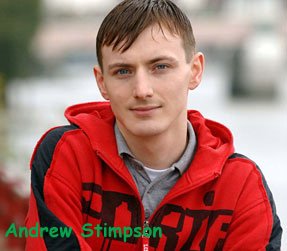 A man who claims to be the first in the world whose immune system has been able to beat the HIV virus was facing mounting pressure yesterday to submit to further vital medical tests. Health experts, Aids campaigners and gay rights activists urged Andrew Stimpson to come forward following claims that he has been able to rid his body of the virus after taking little more than vitamins.
Activists say that if the claims are true, the phenomenon could potentially bring countless benefits to millions of people infected with HIV. There are more than 53,000 in the UK alone.
Mr Stimpson, 25, twice tested positive at the Victoria Clinic for Sexual Health in west London in August 2002. A test 14 months later appeared to be negative. But the heath trust concerned, Chelsea and Westminster, yesterday said Mr Stimpson had so far "declined" to undergo further tests. It is understood that he was first asked to do so immediately after last year's negative test result.
A spokeswoman said: "I can confirm that he has a positive and a negative test. I can't confirm that he's shaken it off, that he's been cured. We urge him, for the sake of himself and the HIV community, to come in and get tested.
Though Mr Stimpson insists he will "do anything I can", associates said yesterday that he had gone away to rest and escape the media spotlight.
Campaigners are annoyed that having not yet undergone the vital tests, Mr Stimpson nevertheless signed contracts with the News of The World and the Mail on Sunday, both of which published his claims yesterday.
They also sounded a note of caution, noting that disclosures in his case arose not from medical research or peer review but from legal correspondence relating to an action Mr Stimpson was pursuing against the health trust. He had feared the positive results might have been wrong and had sought compensation. The trust's contention that both sets of blood tests were accurate emerged as it tried to defend itself from litigation.
Mr Stimpson, who lives in London with his partner, who is HIV positive, said: "There are 34.9 million people with HIV globally and I am just one person who managed to control it, to survive from it and to get rid of it from my body. For me that is unbelievable - it is a miracle. I think I'm one of the luckiest people alive.
"I was just taking daily supplements to keep myself as healthy as possible so as not to get full-blown Aids."
But Annabel Kanabus, director of the Aids charity, Avert, said he must match words with deeds. "He must come forward. Organisations such as ours will be inundated this week. There is enough confusion surrounding the issue of HIV. We don't need any more."
She said the sequence of events is troubling. "He was told in October that he would not be paid by the trust so he goes to the newspapers. I think he should have gone straight to his doctors."
Peter Tatchell, of the campaign group Outrage, said Mr Stimpson must "cooperate with the medical authorities for the greater benefit of everyone who has HIV".
Deborah Jack, chief executive of the National Aids Trust, added: "Without further tests it is impossible to draw any conclusions for people living with HIV. The virus is extremely complex and there are many unknowns about how it operates and how people's bodies react to it."
Mr Stimpson, who works in a sandwich bar, moved to London four years ago from Largs in Ayrshire. He took as confirmation of his cure a letter from the NHS Litigation Authority. Edwina Azimi, the authority's case manager, is reported to have denied any false diagnosis, hailing the results as "exceptional and medically remarkable". She said: "You have recovered from a positive antibody result to a negative result." She said there is "particular interest in these rare circumstances".
Whether doctors formally referred the matter to the Health Protection Agency, which monitors the spread of infection throughout the UK, is unclear. Such a referral would be expected to take place in a case of such apparent significance.
Experts stress the potential benefits a genuine case could have for the development of treatments and vaccines. But they also warned that the complexities of HIV make any one of a number of scenarios possible in this case. Tests usually indicate antibodies rather than the virus. They are usually accurate but one of the number of tests he has undergone may have been wrong. In any event a test for the virus itself is more conclusive.
Dr Patrick Dixon, founder of the international Aids agency ASET said a few people have immune systems capable of preventing HIV from becoming established. "It would not be surprising if we find a tiny number of people who have the capability to destroy the infection. It is possible this individual has something special about his genetic code." But he added: "The answer may turn out to be very complex. We must not jump to conclusions."
from Guardian Unlimited
 It was in the middle of sixth grade when I started to question the nature of my feelings toward other boys.
I always looked at girls as friends, nothing more, nothing less. I would often have thoughts that seemed strange about boys. I would envision being with them, like the boys and girls in the halls holding hands and kissing, not wanting to break apart from each other.
For the first time, I questioned whether or not I might be gay. I did my research to see how other gay people felt toward people, and I concluded that I was indeed homosexual.
Toward the end of my sixth-grade year, I came out to my best friend at the time.
He was the first person I ever told.
I thought that he would understand or at least accept me, and for a while he did. But then about two months later he stopped calling me and hanging out with me. At first, I thought that maybe he was busy with his school subjects, so I didn't question his not speaking to me.
But one day I became curious just to see if he was really busy with his school work and when I asked him what was going on, he said in a kind of disgusted tone that he didn't want to be my friend because I was gay. After I told him, he tried to get some of my other friends to abandon our friendship, but, it didn't work as he planned.
At first I denied it. I didn't feel ready to tell my other friends, in fear that it would get around the school that I was gay.
But, as more and more of my friends asked, I felt bad because I was lying.
So in November 2002, I told a few people I knew I couldn't trust. I did this to decrease the number of times I would have to come out and I knew these people would tell.
Still, to this day, it's one of the hardest things I have had to do.
During the summer of 2002, before entering seventh grade, I was debating whether or not to tell my mother my secret. Visions of disownment and being kicked out of my house ran through my head. Would she love and accept me for who I was? Now, when we go back to that day, my mother recalls that I was very nervous when I told her that I had a “big” secret to reveal. After telling my mother I was gay, she didn't go off the deep edge. She didn't scream, shout or cry. She simply responded with, “I thought that you were going to tell me you killed someone.”
But in the fall of eighth grade, I went through hell. Word had gotten around about my sexuality and almost the entire school knew I was gay. The other students would verbally harass me. Thank God they were never physically violent. I would always get the usual insults: Fag and other words that I can't say were their favorite names for me. Insults would be thrown at me when a teacher wasn't around, such as in the halls or in the locker rooms.
But it really was never bad in the locker rooms; I always had a whole row of lockers to myself. Lockers were never assigned so we were able to pick our own. Other boys never chose the row I picked and I, not wanting to cause problems, never chose a locker near anyone else. Therefore, I always ended up by myself, as nobody really wanted to associate with me. I didn't check any of the guys out, even though it would have been only natural. I didn't want to cause a reason for guys to be afraid of me. I respect the fact that they are heterosexual; I would never try to come on to them.
It was amazing the effect coming out had for both students and staff at East Middle School. East Middle never had a student come out before, and because of this, many policies were more closely followed. Homophobic remarks were dealt with, in most cases with an after-school detention. The teachers were very supporting of me, they always told me if I needed to talk or needed help with students harassing me to let them know.
I am now in 11th grade at Auburn High School. Luckily, I don't deal with the harassment I used to deal with in middle school. There are still many people who dislike me, many of whom moved up from the middle school with me. I have never made peace with anyone who was homophobic, but I am willing to. My belief is that people can change their views when they are willing to look at things with an open mind.
Those who still dislike me will occasionally walk by me and tell me that I am wrong and will go to hell for being gay.
But in most cases people don't bother me at all. In high school as in life, we meet different people, some whom we love and some we don't. Some people are more accepting of others, but some will never be.
The creation of the Gay Straight Alliance at Auburn High School is just the beginning of the changes today's youth will cause. If young people want something, they will work for it and in most cases they will succeed in creating change.
Robbie Schmicking is a junior at Auburn High School
from Auburnpub.com
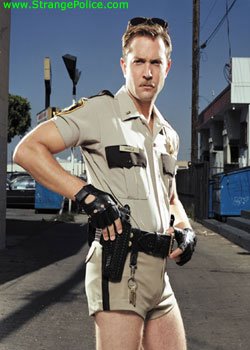 MISSOULA, MONTANA — His pleasant demeanor and baby face aside, Sgt. Scott Oak is a tough cop.
You might have seen him patrolling Missoula’s streets on a motorcycle oblivious to the cold and, if you’re lucky, zooming past your rig to nail a speeder.
When the roads get icy, he’ll be assigned a police cruiser, though much to his chagrin.
As a law enforcement officer in Missoula and Great Falls, and as a cadet in the U.S. Air Force, Oak earned the respect of Montana’s law enforcement community.
His thoroughness as a patrol officer and painstaking attention to detail in reports and investigations didn’t fall below the radar of Police Chief Rusty Wickman.
So when Oak volunteered as liaison officer to Missoula’s gay and lesbian community — a position the department had long been considering — Wickman pledged his support, and told the motor cop to make it happen.
That was just over two weeks ago, and already Oak is proving his mettle as the gay, lesbian, bisexual, transgendered and intersex — or GLBTI — liaison.
A gay man recently told Oak he’d been receiving harassing e-mails from someone he suspected was a police recruit.
Oak told Wickman about the complaint.
“Well, if he is a recruit, then he’s not anymore,” Wickman said.
When Oak determined that the harasser was not a recruit, he informed the gay man that criminal charges were still a possibility, but he had to provide information to file a report.
“He wasn’t comfortable telling me his name or filing a report,” Oak said.
Oak, who is openly gay, hopes to quell those fears within the GLBTI community, making himself visible as a cop who cares and understands.
“Through this position, I want to be a direct link between the GLBTI community and the police department,” Oak said.
On Thursday, the Western Montana Gay & Lesbian Community Center held a “meet and greet” to introduce Oak and explain his new position.
The idea is for an officer to work more exclusively with the underserved gay community.
And while Oak won’t abandon his normal duties, he’ll spend a large chunk of his time ensuring crimes targeting the GLBTI community are properly documented and investigated.
It’s a link that many men and women attending Thursday’s gathering say is missing, and has been for a long time.
Sitting in the community center’s cramped meeting room, Oak, Wickman and Detective Guy Baker fielded questions from more than 30 people.
“We’ve needed to establish a better relationship with the GLBTI community for a long time,” Wickman told the group. “And I don’t think we’ve done a very good job of that in the past. I apologize this wasn’t done three years ago.”
Wickman, who has been chief for only about six months, said he’s wanted to create a position like Oak’s for a long time.
But last month, an unprovoked attack on two 21-year-old University of Montana students jump-started the effort.
On Oct. 15, a group of teenagers screamed anti-gay epithets at Marcus Chebul and Wally Catton, then beat the men so severely they were both hospitalized.
Catton’s jaw was broken in two places and had to be wired shut, while Chebul suffered a fractured cheekbone and a concussion.
While both men are heterosexual, the attack generated a sense of urgency in Missoula.
“The line between harassment and assault can be very thin,” Wickman said. “There are barriers between the gay community and the police department, and I need to know what those barriers are. We are your police department, too.”
While Wickman said incidents of assault aren’t increasing in Missoula, the violence of the attacks has become more severe.
“The numbers aren’t going up,” Wickman said. “But what we’re seeing is a lot more brutal violence.”
Missoula is the only city in Montana to have a GLBTI liaison officer, and the only city of its size in the nation with such a position.
Wickman told the group of people Thursday night that he wants to know just how much underreporting the police department is getting from the GLBTI community.
“If someone isn’t out, then they’re going to be worried about reporting something and giving their name to a police officer,” a woman said.
Bobby Tollefson, editor of the publication “Gayzette,” said he works at City Hall, and knows which officers are or are not gay friendly.
“I know. We have to clean up our own backyard, too,” Wickman said.
And Oak has created a temporary solution for underreporting. Last week, Wickman approved the Missoula Hate Crime and Bias Incident Report.
It allows someone to file a complaint anonymously.
While a victim would have to give his or her name for actual criminal charges to be filed, Oak said the reports will at least generate some statistics and alert him to problem areas in Missoula.
Oak is still trying to determine how the new position can be most productive.
Searching for direction, he contacted Sgt. Brett Parson, the head of the GLBTI Liaison Unit for the Washington, D.C., police department.
“The first step is the biggest step,” Parson said. “And that’s creating the position. It’s a huge step for the chief, and for the entire city.
“The next step is getting the community and the officers to buy in. The way to do that is to continue to be a good cop, continue to do all the things you’ve always done to build a reputation.”
When Parson took over the D.C. unit in 2001, his biggest concern was whether it would change his reputation.
“Before that, my reputation was as a tough (expletive) cop,” he said. “Now it’s as a gay cop. But this is a new kind of community policing, and it’s not something that everybody is used to.”
Each Friday, Parson teaches a training course at the D.C. police department called Gay 101.
He also travels around the country and offers the same course to police departments trying to reach out to the gay community.
Diversity and sensitivity training are priorities for the Missoula Police Department.Oak said beginning next week, every field training officer at the department will attend mandatory diversity training.
New police recruits are assigned a field training officer a more experienced cop to shadow for 14 weeks.
Oak says targeting the field training officers will help extend the attitude to the recruits.
“If they have biases, they’ll reflect those onto the trainees,” Oak said. “It will be good for the recruits to see that officers and command staff have bought into this.”
On behalf of the police department’s detective bureau, Guy Baker volunteered to be a contact for the GLBTI community.
Because investigations often take place behind the scenes, Baker said their extent is rarely known.
“Unless there is a criminal charge filed, the case won’t become public record,” he said. So it’s easy to say we didn’t do anything.”
Last month, Oak read an e-mail from a gay man who said he was afraid to go downtown because of anti-gay harassment. It was the impetus for his decision to volunteer as Missoula’s first GLBTI officer.
“That really opened the can of worms,” Oak said. “But I think this is exactly where we need to be as a police department.”
Since the position was created, Oak said he has to check his e-mail every hour.
The community reaction has been so encouraging, he’s certain he did the right thing.
Parson is certain of his decision, too.
“I always have to ask myself, ’Is this why I became a cop?’ “ he said. “In the end, where I come down is ’Yeah, it is.’ “
Although police work in a large city is more extreme by nature, Parson said you never know where the need might exist for cops like Oak.
“Regardless of whether there’s an actual need for it, perception is everything,” he said. “If you have members of the community who perceive there’s a problem, then there’s a problem.”
from Helena Independent Record
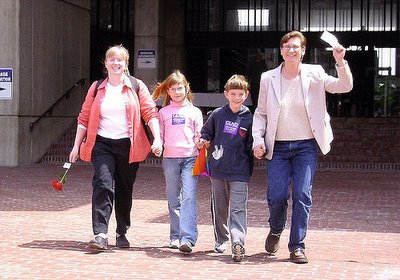 OAKLAND, CALIFORNIA - The queens get all the attention. The politicians grab all the headlines.
But in the battle for gay rights, the children of lesbian, gay and transgender parents often pay the price.
It could be small, like having only one parent legally able to sign a permission slip. Or big, like the risk of foster home should something happen to their biological parent. Or personal, like rejection from an uncle or grandfather.
For the past three days at the Oakland Convention Center, nearly 2,500 activists nationwide from the gay, lesbian, bisexual and transgender community have gathered to organize, strategize, and push the gay movement forward.
The national debate has recently focused on gay marriage. But for many the bigger concern is social justice, said Matt Foreman, executive director of the National Gay and Lesbian Task Force, sponsor of the Creating Change Conference.
"For the vast majority of gay people, the issues facing their daily lives are not the marriage license. ... It's whether you can see a partner in a hospital or get Social Security benefits."
Or feel welcome at church.
"Children (of gay parents) face discrimination on so many levels," said Beth Teper, director of Children of Lesbians and Gays Everywhere, or COLAGE. "Religious institutions are blasting our families, spreading messages of hate, when we know our families are all about love."
Saturday's conferencepresented "In My Shoes," a movie produced by middle and high school-aged participants in the San Francisco-based program.
It featured Alex, 11, who used to lie about why he had two mothers.
And Marina Gatto, daughter of two lesbians, who was told by a teacher to "make up a father" as her classmates traced their family trees.
"Our families aren't easy. In fact they're very complicated. We're being very creative in how we create our families. That's something the media is not quite ready for," said Meredith Fenton, COLAGE's program director who is a daughter of lesbians.
"These are youth. They just want you to hear their stories."
from The Oakland Tribune
 DALLAS, TEXAS - About 3,200 people are expected to attend the International Gay Rodeo Association’s Finals Rodeo this weekend in Dallas, according to Karroll Parker of Fort Worth, rodeo director.
The finals rodeo is being held in Dallas for the first time in its 19-year history, and Parker said coordinators were thrilled to be able to hold the event in the Resistol Arena in Mesquite.
“This is one of the most highly-acclaimed arenas on the circuit,” Parker said. “We have moved into the straight man’s rodeo world now.”
The Resistol Arena is home to the world-famous Mesquite Champion-ship Rodeo held each spring and summer. Owned by Tom Hicks, the arena is a fully-air-conditioned indoor facility with seating for 5,500, including luxury suites.
The arena is located at I-635 at Military Parkway, about 15 minutes east of downtown Dallas. Parker said the well-lighted arena is not only a great place to compete, but also allows spectators to be close to the action.
Holding the IGRA Finals Rodeo in one of the best professional rodeo arenas around is fitting, Parker said, since those competing in the event are “the best of the best” in the gay rodeo world.
They come from 25 member associations around the U.S. and Canada, and accumulate points by winning at 22 rodeos sponsored by member associations throughout the year. The top 20 contestants in 13 events, based on point totals, are then invited to compete in the finals rodeo, Parker said.
Those events include the rough stock events like bull riding, bronc riding and steer riding, timed events like barrel racing, pole bending, calf roping and steer wrestling, and the ever-popular “camp events” — steer decorating, goat dressing and the wild drag race — that are unique to the gay rodeo circuit.
Several North Texans are on that “best of the best” list and are expected to compete at the finals rodeo this weekend.
Candy Pratt of the Red River Rodeo Association ranks in the top 20 in seven events. She is the top-ranked woman in pole bending, the flag race and mounted breakaway roping.
Pratt is ranked fourth in barrel racing and calf roping on foot, and eighth in team roping. She also qualified for the wild drag race by placing 17th.
Wade Earp of Dallas, a Texas Gay Rodeo Association member, qualified for the finals rodeo in five events. He is ranked fourth in steer
riding, fifth in bull riding, sixth in bareback bronc riding, ninth in the flag race and 19th in steer decorating.
Doreen Rue, another Red River Rodeo Association cowgirl, qualified for the finals rodeo by placing third in pole bending, seventh in barrel racing and 14th in both the flag race and calf roping on foot.
Top-ranked bull rider Steve Daigle is expected to compete this weekend. Daigle, who is also ranked third in steer riding, is from New Orleans. But after being displaced by Hurricane Katrina, he is living in Dallas and is a member of the Red River Rodeo Association.
Other top cowboys expected to compete at Resistol Arena are Tee Tramp of the Atlantic States Gay Rodeo Association and Chuck Browning of the Arizona Gay Rodeo Association.
Tramp is ranked first in bareback bronc riding and steer riding, second in bull riding, fifth in pole bending, eighth in barrel racing, 12th in the flag race and 13th in chute dogging. Browning is second in goat dressing, third in bull riding, fourth in steer decorating, eighth in chute dogging, 11th in calf roping on foot and 17th in the flag race.
from Dallas Voice
 PROVIDENCE, RHODE ISLAND - Belle Pellegrino was a Marine private first class stationed in California in 1969 when she told her commanding officer she was gay. She endured two weeks of interrogation and humiliating questions from two male officers before she was kicked out.
On Friday, she marked Veterans Day with a handful of other veterans -- gay and straight -- by calling on Congress to repeal the "don't ask, don't tell" policy that bars people who are openly gay from serving in the military.
"'Don't ask, don't tell' is nothing more than the latest excuse for treating us as less than full citizens," said Pellegrino, 61, of Providence.
The policy also is driving skilled servicemen from the armed forces at time when recruiting is suffering, veterans and gay rights advocates said.
The Army was 6,627 recruits short of its goal of 80,000 for the year ending Sept. 30. The other branches met their goals but have far smaller recruiting needs.
"We need to do something," said Matt McTighe, a lobbyist for the Human Rights Campaign, a Washington-based group that works for gay rights. "This is one area where we've got troops willing to serve."
The group chose Providence to hold its national Veterans Day event in part because its Congressional delegation supports gay rights, McTighe said.
The Clinton administration introduced "don't ask, don't tell" in 1993. It prohibits the military from inquiring about service members' sexual orientation but requires it to discharge those who acknowledge being gay. More than 9,400 service members have been discharged under the policy.
The California General Assembly and a number of cities, including New York and Chicago, have passed resolutions asking Congress to repeal the policy.
Anne Wallbillich intended to make the Air Force her career when she signed up 1989. But four years later, she chose not to re-enlist because of 'don't ask, don't tell.' She didn't tell her commanding officer she was gay, and when she went to sign her discharge papers, he asked her if there was any way he could keep her from leaving.
"I said, 'No Colonel, I don't think there's anything you can do,'" said Wallbillich, 40, who now lives in North Smithfield and works as a hospital laboratory supervisor.
Wallbillich and other veterans said they hope legislators will support the Military Readiness Enhancement Act, a bill introduced in March that would allow gay service members to serve openly. Reps. Patrick Kennedy and Jim Langevin, both Rhode Island Democrats, support the bill.
Jeff Schmalz, 49, of Dartmouth, Mass., said he left the Army National Guard in June 2004 after 25 years of military service because he and his partner were discussing marriage and he feared the loss of his pension. Several friends who are commanding officers tried to persuade him to stay, Schmalz said.
"They said, 'Look, we don't want to lose people. We don't want to lose skilled people,'" he recalled. "But it wasn't his pension on the line."
from Boston.com
 TOMS RIVER, NEW JERSEY — A tearful jury forewoman announced to a packed courtroom Thursday that former surgical nurse Richard W. Rogers Jr. was guilty of the murders of two men whose decapitated, dismembered remains were found at roadside locations in New Jersey in the early 1990s.
Rogers, 55, of Staten Island, a suspect in three other murders in other states, appeared emotionless and looked at the front of the courtroom as the forewoman read the verdict while crying, dabbing her tears with a tissue and clutching the hand of another juror.
Rogers was convicted of the murders of Thomas Mulcahy, 56, a married, bisexual businessman from Sudbury, Mass., and Anthony Marrero, 44, a gay prostitute from Manhattan. The jury also found Rogers — who had been a nurse for 20 years at Mount Sinai Hospital in Manhattan — guilty of two counts of hindering his own apprehension by dismembering and disposing of the victims' bodies.
He faces up to life in prison with a minimum of 30 years without parole on each of the murders.
"We're just pleased. We feel justice has been done," said Mulcahy's widow, Margaret.
Rogers' attorney, David Ruhnke, said he plans to file an appeal.
The jury reached a verdict at 6 p.m., after deliberating about three hours and 45 minutes following a trial that began Oct. 26 and included a spate of grisly evidence.
Where were men killed?
The verdict came less than an hour after Superior Court Judge James N. Citta answered the panel's question about whether New Jersey had jurisdiction in the matter.
Ruhnke had argued to the jury that it could not convict Rogers of the crimes because the state had not establishedthat they occurred in New Jersey. Citta explained that the law allowed, but did not require, the jury to infer that because the bodies were found in New Jersey, the murders occurred in New Jersey.
Although the state presented strong evidence, including a total of 36 of Rogers' fingerprints on bags of body parts, investigators never established where the murders occurred, and witnesses testified the victims were last seen alive in New York.
Had the jury not convicted Rogers, he could have walked free. Instead, Citta discharged Rogers' $1 million bail and remanded him to the Ocean County Jail pending sentencing in January.
"I feel better that he's not walking the streets," William J. Heisler, chief trial attorney in the Ocean County Prosecutor's Office, said after the verdict.
During pretrial hearings, Citta ruled that evidence of two of the three other murders Rogers is suspected of, although not charged with, could be introduced to the jury because of similarities to the New Jersey case.
Mulcahy, a father of four, went to Manhattan on July 7, 1992, for a business presentation and disappeared the following day. One of the last places he was seen was the Townhouse, a gay bar on Manhattan's EastSide that Rogers was known to frequent.
Mulcahy's body parts were discovered July 10, 1992, at a Transportation Department maintenance yard in Burlington County, and in a trash barrel at the Stafford Forge Rest Area on the Garden State Parkway in Stafford. Rogers left 16 fingerprints on the bags that contained Mulcahy's remains.
Remains in Manchester
Marrero's dismembered body was found in plastic bags on May 10, 1993, on a dirt road in Manchester. Authorities detected two of Rogers' fingerprints and his palm print.
The jury also heard about the murders of Peter Anderson and Michael Sakara.
Anderson, 54, a homosexual banker from Philadelphia, attended a political fund-raiser in Manhattan on May 3, 1991, and later had drinks at the Townhouse, one of the last places he was seen alive. His sexually mutilated body was found May 5, 1991, in a garbage bag in a trash barrel at a rest area on the Pennsylvania Turnpike in Lancaster County. Rogers' palm print and 18 of his fingerprints were on the bag.
Sakara, 55, a homosexual typesetter from Manhattan, was last seen alive in the Five Oaks, a gay bar in Manhattan's Greenwich Village, with Rogers on July 30, 1993. His severed head and arms were found the next day in garbage bags in a trash barrel on Route 9W in Haverstraw, Rockland County, N.Y.
On Aug. 8, 1992, more of Sakara's severed remains were found in trash bags nine miles north on Route 9W in Stony Point, Rockland County.
Citta ruled the jury could not hear about Matthew John Pierro, 21, of Bloomfield, found dead on April 10, 1982, off Interstate 4 in Lake Mary, Fla., with a bite mark on his chest that dentists said was made by Rogers.
The jury also did not hear that the fingerprints left at the crime scenes were matched to Rogers in 2001 after the state of Maine went online with an automated fingerprint-identification system.
The panel also did not know that Rogers' fingerprints were on file in Maine since 1973, when he stood trial for the murder of his roommate, Frederick Spencer, in Orono and was acquitted after claiming self-defense.
Spencer had been repeatedly struck on the head with a hammer, smothered with a plastic bag and dumped in a wooded area.
from Asbury Park Press
 A man who claims to be the first in the world whose immune system has been able to beat the HIV virus was facing mounting pressure yesterday to submit to further vital medical tests. Health experts, Aids campaigners and gay rights activists urged Andrew Stimpson to come forward following claims that he has been able to rid his body of the virus after taking little more than vitamins.
