Showing posts with label Transgender. Show all posts

Saturday, June 6, 2009

Radio Hosts Refer To Transgender People As 'Freaks'

Transgender
SACRAMENTO — Bank of America, Verizon, Chipotle and other companies have pulled advertising from a Sacramento radio station after talk show hosts referred to transgender people as “freaks” with mental disorders.
During a May 28 show, one of the three hosts on KRXQ’s “Rob, Arnie & Dawn” show said he would hit his son with his shoe if he put on high heels. Another said he would tell a boy he was “a little idiot” if he asked to wear a dress.
Officials with Bank of America Corp. and Chipotle Mexican Grill Inc. said Friday their companies pulled advertising because they found the comments offensive.
“We listened to the segment and the follow-up comments, and found it quite difficult to defend,” Bank of America spokesman Joe Goode said.
Representatives of Verizon Communications Inc., Nissan Motor Co. and Carl’s Jr. restaurants also said they stopped advertising.
Transgender advocates and the Gay and Lesbian Alliance Against Defamation have sought an apology from two of the show’s three hosts, Arnie States and Rob Williams. The third host, Dawn Rossi, defended transgender people on the show.
“Our issue here is that Rob and Arnie advocated violence against children because of who they are and have failed to take responsibility for their dehumanizing and defamatory words,” said Rashad Robinson, senior director of programs at GLAAD.
John Geary, vice president and general manager of KRXQ, did not return a telephone message or e-mail Friday.
During a follow-up show Wednesday, States said he never advocated abuse. He said his comments were meant only as a joke and that he didn’t do anything wrong, according to a report in The Sacramento Bee.
During the May 28 broadcast, States and Williams discussed the California Supreme Court ruling upholding Proposition 8, the initiative on last November’s ballot that banned same-sex marriage. The hosts then turned their attention to transgender lifestyles.
“If my son, God forbid, if my son put on a pair of high heels, I would probably hit him with one of my shoes. I would throw a shoe at him,” States said on the air.
Williams suggested transgender people suffered from a mental disorder.
“They are freaks. They are abnormal,” he said. “Not because they’re girls trapped in boys bodies, but because they have a mental disorder that needs to be somehow gotten out of them.”
from Entertainment Daily


Randy Blue

Monday, June 18, 2007

New JerseyTransgender Law To Go Into Effect

Transgender
NEW JERSEY - Starting Sunday, New Jersey joins eight other states in making it illegal for employers and landlords to discriminate against transgendered people.
The law, which sailed through the Legislature in December, has received little attention in a state that's gaining a reputation for being welcoming to lesbian, gay and transgendered people. Earlier this year, New Jersey began allowing same-sex couples to unite in civil unions.
Advocates hope the new law will lead to more acceptance and awareness of people who are born one gender but live as the opposite gender. Mara Keisling, executive director of the National Center of Transgender Equality in Washington, said she expects more states to follow, including a handful in 2007 and 2008.
"It's really simply a reaction to there being more (transgender) people who are out," Keisling said. "As more people transition, it becomes safer to transition."
The law makes it illegal for a landlord to evict a tenant because of his or her gender status, and companies cannot refuse to hire people because they are transsexual, cross-dressers, asexual, of ambiguous gender or simply not traditionally feminine or masculine. The law also bans discrimination in credit, business contracts and public accommodations such as stores or restaurants.
Labor law posters at work places notifying workers of their rights will include the transgender protection. Violators could be subject to up to 90 days in jail or fines up to $500.
The first such state law was adopted in Minnesota in 1993. Rhode Island, New Mexico, California, Illinois, Maine, Hawaii, Washington and the District of Columbia have adopted similar measures.
By January, laws also will be in effect in Iowa, Vermont, Colorado and Oregon.
In New Jersey, legal protections have been in place since a 2001 state appeals court ruling that held it was unlawful to discriminate against a transsexual doctor.
Advocates say many employers and landlords and even transgendered people themselves did not know about that decision, known as Enriquez v. West Jersey Health Systems, or the protections it offers.
Despite the legal protections, transgendered people say discrimination happens too frequently.
Coy Gordon, who was born a man but has lived as a woman since high school nearly 30 years ago, said she believes she's been rejected for work because she is transgendered.
"To them (employers), I'm still a freak," said Gordon, 43, an unemployed counselor who lives in Jersey City.
Unable to get jobs, she said, transgendered women often have little choice but to turn to prostitution.
Jillian Todd Weiss, an assistant professor of law and society at Ramapo College in Mahwah, who is also a transsexual, said the law might make people treat transgendered people better, but it won't necessarily change attitudes or beliefs.
"It's very difficult to legislate away prejudice," she said.
New Jersey gay and transgendered rights leaders said passage of the transgender bill was as much a priority for them as the state's civil unions law, which took effect in February.
"I have never had an easier time lobbying than for this bill," said Steven Goldstein, chairman of Garden State Equality, an advocacy group that pushed for the law.
from The Associated Press

Monday, May 21, 2007

Transgender Wins Prom Queen

Johnny Vera
The silver tiara matched his silver stilettos when Johnny Vera was named prom queen Saturday night at Roosevelt High School.
He's the first transgender prom queen in Fresno -- and possibly anywhere.
Vera's win probably didn't surprise anyone who had seen the prom queen candidates' speeches Friday in the quad during lunch. Vera, effeminate and towering in heels, had wrapped his manicured nails around the microphone.
"For me, it's about more than a crown. It's about saying to people, 'Come out and be who you want to be,' " Vera said. A crowded, urban high school scene paused to listen. "You have to say, 'I am who I am, and I'm proud of who I am. My spirit will never be down on the floor.' "
The students cheered and whistled. The girls on Vera's cheerleading squad got teary-eyed. A boy wearing a pin supporting another queen candidate started the chant: "Johnny! Johnny! Johnny!"
On Saturday night when his name was announced, Vera wept like a newly crowned Miss America to thunderous applause in a downtown Radisson Hotel ballroom. The same chant started: "Johnny! Johnny! Johnny!"
Vera's crowning comes less than a month after Cinthia Covarrubias made national news by running for prom king at Fresno High School.
Covarrubias didn't win but said at the time of her candidacy that she hoped to break the ice for other students who are transgender, a term for people whose gender identity or expression differs from the sex they born with.
Vera didn't know Covarrubias. But he was inspired.
"Things are the way things are until someone changes it," Vera said. "I started seeing that someone has to be first."
Take away the fact that Vera has his face regularly waxed to remove stubble, and he is in many ways a typical prom queen: good grades, a cheerleader and popular.
Vera prefers the pronoun "she," but most people at Roosevelt High refer to Vera as "he." Vera isn't too hung up on pronouns.
"You have to let the little stuff sweat right off," Vera said.
At football games when he's on the cheerleading squad, the crowd regularly chants, "Johnny, Johnny, Johnny."
"No other student is getting their name chanted," said Lupe Sosa, a career counselor at Roosevelt.
What happened to the age-old story of someone different not fitting in during high school? Sosa said Vera's strength of character compels people to accept him.
"This person is amazing. He lights up everybody around him," Sosa said. "He always has a genuine compliment for everyone. Especially the shy kids. But he never sugarcoats anything. Johnny carries himself with a lot of dignity. And Johnny is so darn assertive. No one messes with Johnny."
When Sosa recounts conversations she's had with Vera, she adopts his persona, adding a head toss and shoulder shrug to her words. The week before the prom, she saw "a student jealous of Johnny" tearing down one of his posters.
"I said, 'Oh, Johnny, how does that make you feel?' He laughed. He said," -- and she snaps her fingers, re-creating Vera's delivery -- " 'Oh Mrs. Sosa. I am not going to trip over that. They're tearing down a poster, not my spirit.' "
Sosa advised Vera to think hard before running.
"I couldn't say it's a perfect world, people are always kind. I told him, 'Be ready for consequences,' " she said.
But Sosa has been surprised at how little controversy there has been. She was in the stands at homecoming when students were shouting Vera's name. She watched confused parents ask their children who Johnny was. That wasn't the homecoming queen's name.
"The kids pointed to Johnny down on the field in his cheerleading outfit. The parents looked so surprised. I just had to laugh," Sosa said. "It's really a different world."
The administration of Roosevelt High School had no problems with Vera running for prom queen.
"It's not our job to judge. We don't allow discrimination in any form here," said Vice Principal Ovidio Martinez.
He figured Vera had a good chance: "He's well-known. He stands out. He's 6-foot-4 in heels."
Assistant Principal John Leal had expected Vera to grab the crown. "Word up from the kids is he's a 5-to-1 favorite," he said before prom.
Leal describes himself as a "traditional Mexican macho."
"But I like Johnny," he said. "He's a good guy. Everybody loves Johnny. He stands his ground. I remember the winter formal -- he was dressed in a beautiful dress by the way -- no one batted an eye." At the spring homecoming, Vera was named Mr. Roughrider.
"It was an honor, but I don't like being called mister," Vera said.
Some students at the prom did think twice about voting for a transgender prom queen.
"I think it could be cool if Johnny won, but I was worried about the school's reputation," said Angel Bustamante, 17, a senior. "Then again, it doesn't matter what other people think. That's the message he's trying to get across."
Johnny VeraHis date, Lily Vasquez, gave him a playful slap.
"You didn't vote for Johnny?" she said.
Even one of the other prom queen candidates didn't understand why there would be a fuss over Johnny winning.
"I think a guy should be a king and a queen should be a girl, because I'm old-fashioned," Erica Cossio said before the vote. "But I don't think it's going to be surprising if he wins. It's not like some huge deal."
Before coming to Roosevelt, where he's preparing for a career as a fashion designer, Vera said he didn't have a place he felt safe. Even when he presented himself as male with short hair and more masculine clothing, he was sometimes singled out.
"Even as a more guyish Johnny, I was real soft, real gentle," he said.
In Santa Ana, where he lived until he was in high school, he said he made sure never to go anywhere alone, because he was worried about being beaten up.
Vera said his source of strength was his mother, Maria, who died of complications from lupus when he was 14.
"She was a woman who liked to dress herself up. She was very excitable, all smiles, like me," he said. "And she knew how to manage things. When my dad came home, the house was clean, the meal was cooked and we were all dressed."
Vera's sister, Elizabeth, 21, said her mother never made an issue of Johnny's differences.
"Just because he was different than every other little boy, she never put it out there as a problem," she said. "It was 'we love each other,' and that was it."
When his mother was sick, she talked to him about self-respect.
"She taught me to be strong and never be ashamed of myself," Vera said. "Never see yourself as less, she said. She told me, 'You know, to really be a lady you have to know how to walk into a room.' "
Elizabeth Vera said she's proud of having a brother who is a prom queen.
"He's standing up and saying it's OK to be different," she said. "There's so many ignorant people out there. I've seen them look at my brother like he's some kind of disease. I've seen the reactions.
"I've always felt like, you don't like it, that's fine, but don't disrespect my brother," she said. "Now he's going to make people talk. He's going to open a lot of eyes. Just to show that kind of courage shows who my brother is."
In the dark days after Vera's mother died and his family moved to Fresno, he would walk to school every day repeating to himself mantras of inspiration from sources ranging from Mohandas Gandhi to classroom posters:
"Be the change you want to see in the world -- believe in yourself -- if you can dream it you can become it."
"There were all those statistics about transgender kids committing suicide. People would look at me and say I was going to do drugs or be a prostitute. And I would just tell myself, I'm not going to let anyone but me tell me what I'm going to be."
On Saturday night, he was prom queen.
from The Fresno Bee

Saturday, April 21, 2007

Transgender Student Runs for Prom King

Cinthia Covarrubias
FRESNO, CALIFORNIA - When school officials announce the name of the Fresno High School prom king on Saturday, Cinthia Covarrubias will be wearing a tuxedo just like the six boys vying for the honor. Administrators agreed to reverse a district protocol this week that limited males to compete for the title after Covarrubias was nominated by her classmates.
"I would never have run for anything if I had to wear a dress," said Covarrubias, who considers herself transgender, an umbrella term that covers all people whose outward appearance and internal identity don't match their gender at birth.
Gay youth advocates called it a landmark victory for campus gender expression and said they believe it's the first time in the U.S. that an openly transgender student has run for prom royalty.
"We are growing as a society to accept much more diversity in gender expression, and that's a positive thing," said Carolyn Laub, director of the Gay-Straight Alliance Network.
Covarrubias, who wears black-and-white Vans, baggy shorts and close-cropped brown hair, sometimes identifies herself as Tony. Her date, a close female friend, plans to wear a black dress and red corsage to the prom at an outdoor reception hall surrounded by man-made waterfalls.
On Wednesday, officials at the school of 2,700 students shifted course, saying the district's lawyers had recommended adding Covarrubias' name to the ballot to comply with a 2000 state law protecting students' ability to express their gender identity on campus.
"We always want to do the right thing by our students," Vice Principal Sheila Uriarte said. "This is why we came to this decision."
Leanne Reyes, 16, said Covarrubias had her vote.
"It's not like the stereotype where the king has to be a jock and he's there with the cheerleaders anymore," said Reyes, a senior. "We live in a generation now where dudes are chicks and chicks are dudes."
Still, some students criticized the decision to put Covarrubias on the ballot.
"I like lesbians, but they shouldn't be allowed to run for king," said senior Erich Logan, 18, as he stood outside the stately high school building.
A native of Jalisco, Mexico, Covarrubias said she has bucked rigid expectations of how a girl in her culture should behave. Explaining the meaning of terms like "queer" and "transgender" to her parents and eight siblings has at times been painful, she said.
"My freshman year I just started feeling different," she said. "When I decided to change to be like this, all of a sudden I said, 'Wow, I feel OK. I feel like finally I'm being me.'"
She has no current plans, however, to permanently alter her gender through hormones or surgery.
Tiffani Sanchez, a science teacher who advises the school's Gay-Straight Alliance, said the decision would foster understanding of the broad spectrum of gender identities.
"Cinthia is still really learning who she is," she said. "We want her to know that there's a safe space for her here and we support her."
Covarrubias is giddily looking forward to the prom, but acknowledged being a little nervous.
"I'm happy I actually made a difference about changing the law and the policy so you can run for your choice," Covarrubias said.
from The Associated Press

Saturday, March 24, 2007

Transgender Florida City Manager Loses Job

Steve Stanton
LARGO,FLORDIA - City commissioners early Saturday finalized the firing of a city manager who is seeking a sex-change operation, despite pleas from dozens of impassioned supporters to save his job.
After a six-hour hearing, the commissioners decided to fire 48-year-old Steve Stanton after his announcement that he planned a new life as a woman. The move came after the commission voted 5-2 last month to suspend him with pay.
Commissioners contended Stanton was being fired because they lost confidence in him, not because he wants to be a woman.
"I think we're pretty well convinced," Commissioner Gay Gentry said. "You have to believe us, you have to trust us, it is not about transgenderism."
Stanton, 48, triggered the debate in the city of 76,000 west of Tampa last month when he announced his plans at a news conference. Commissioners said Stanton's announcement caused turmoil and work disruption in the city. His contract says he can be fired without cause at any time.
Stanton has not decided if he will sue over the firing.
"I was optimistic, but I knew it would be very difficult to slow down the train," he said following the hearing.
Stanton had asked commissioners to give city employees and the community "an opportunity to show they can embrace a transgender city manager because that person is competent based on their skills, knowledge and education."
Most of more than 70 other speakers - including gay and lesbian activists and transgender people - spoke passionately in favor of Stanton.
"I don't want the city of Largo to be the poster child for bigotry and discrimination," resident Mary Jensen told commissioners.
But others said Stanton bullied city employees, and the publicity generated by his announcement has cast the city in a negative light.
"This little thing has made Largo the laughingstock of the whole country," resident Jimmy Dean told commissioners. "It's a disgrace."
The city commission had given Stanton generally good reviews and a hefty raise last year for his management of the city's $130 million budget and roughly 1,200 employees. But since commissioners put Stanton on leave, some have criticized him for hard-nosed treatment of employees.
Stanton planned to change his name legally in August and begin living as a woman before having gender reassignment surgery in summer 2008.
He drafted an eight-page transition plan to prepare his employees and pursue the sex-change operation. He planned to announce the change this summer. But a St. Petersburg Times reporter learned his secret and he was forced to come out at a City Hall press conference on Feb. 21.
from The Associated Press

Saturday, March 10, 2007

UC Riverside Offers Gender-Neutral Housing For Gay, Transgender Students

Gay Sex
UC Riverside is one of a growing number of universities nationwide that has begun allowing men and women to share a room on campus.
So-called gender-neutral housing was created in 2005 at UCR in response to concerns expressed by gay and transgender students, who told university housing officials that they were uncomfortable rooming with students of the same sex. Now, they can choose roommates regardless of biological sex or gender identity.
Gay and transgender students can benefit from a roommate of the opposite gender, particularly someone they know, because they have an instant support network regardless of where they are in the coming-out process, said Cynthia Hurd, a Fort Collins, Colo.-based psychotherapist who focuses on gender-identity issues.
"It would take the pressure off," Hurd said.
Typically, more freshmen live on campus at UCR than any other class. Of about 3,000 freshmen living on campus this school year, 24 opted to live in the suites. Each of the six suites accommodates up to eight students. So far, just one pair of roommates in the gender-neutral community are of the opposite sex.
"If living with someone of an opposite gender is going to make their transition to college easier, then we should have the option," said Emily Sandoval, resident director of UCR's North Pentland Hills, where the housing is located.
Currently, about 20 universities across the nation offer students the option. About a dozen other institutions, including the nation's oldest campus, Harvard University, are considering it, said Jeffrey Chang, associate director of the National Student Genderblind Campaign, which started in summer 2006 to encourage gender-neutral housing.
Changing Times
The trend reflects societal changes as more men and women are best friends without being romantically involved, Chang said.
"It's far different than 10, 20 years ago," Chang said. "There's a lot more interaction between men and women. I think college campuses are a huge symbol of where our country is going in terms of gender relations. They're interacting on a more equal level."
Hampshire College in Amherst, Mass., is believed to be the first campus to offer gender-neutral housing, Chang said.
The campus has allowed any two people, regardless of gender, to room together since Hampshire opened in 1970, said Hampshire spokeswoman Elaine Thomas.
About 90 percent of the rooms are singles, but about a half dozen each year are occupied by opposite-sex roommates, many of whom are platonic friends, Thomas said. In some years, no one opts for a gender-neutral room. Each individual has to request the other, Thomas said.
'Boundaries' and 'Respect'
Eighteen-year-olds Verenice Quezada and Erving Tu are the only mixed-sex couple living in UCR's Stonewall Hall, which is part of North Pentland Hills.
Tu sat behind Quezada in trigonometry class at Workman High School in Industry. They became good friends who wanted to room together to help ease the transition to college.
Quezada learned about the gender-neutral housing option when she visited UCR, and she suggested the idea to Tu.
"We knew each other's boundaries," Quezada said. "We knew how to respect each other. We already knew what we were like."
Quezada is gay; Tu is straight. The first person that Quezada told about being gay, even before her family, was Tu.
Quezada said that she did not believe she could live in a traditional hall with another young woman.
"I would probably have to hide it from my roommate for a while until I was sure she was OK with it," Quezada said.
When Tu told his family that he would have a female roommate in college, their reaction was: " 'How did you do that?' I said, 'Because she's gay.' They said, 'OK.' "
Gay CoupleQuezada and Tu also share the experience of being the first generation in their families to go to college.
"If I need help with anything, I know somebody is there," Tu said. "Having a friend is really helpful."
Their rules are they can't go through each other's drawers and Quezada's girlfriend can't be on Tu's bed.
Tu helps Quezada arrange her class schedule and is a good listener. Quezada brings Tu food and gives him rides home on the weekends. They also go to the computer lab and the dining hall together.
Tu, who grew up with six sisters, said he believes he has overcome his homophobia by living with gay students.
"I had some dumb, straight ideas about gay people, but I got over it," Tu said.
UCR students say gender-neutral housing offers freedom that doesn't exist elsewhere.
Samantha Hoover, 19, said she likes living in a hall where a student does not have to have a sexual identity. Dating is discouraged among hallmates, she said.
"It's like a safe place for those who don't identify as a gender," said Hoover, a sophomore and the hall's program coordinator.
She said the hall feels more like a family than the traditional dorm she lived in last year and there are no "little cliques."
"This has become our home because maybe we don't have the support from our families," Hoover said.
Gay-Friendly Campus
UCR has a history of welcoming gay students.
Campus PrideNet, a national solidarity group for gay, lesbian, bisexual and transgender college students, included UCR in "The Advocate College Guide for LGBT Students," a 2006 guidebook identifying gay-friendly campuses.
A campus resource center, inclusive housing options and activities targeting lesbian, gay, bisexual and transgender students were among the reasons that UCR was cited in the guide, said Shane Windmeyer, the guide's author.
UCR was the first college campus in California to have a professionally staffed Lesbian Gay Bisexual Transgender Resource Center, Chang said.
The center, opened in 1993, offers weekly rap groups, one-on-one support sessions, a lounge area and a library of books and videos. Since then, the center has grown from having one part-time staff member to three full-time professionals, said center director Nancy Tubbs.
Themed Dormitories
Transgender staff members helped launch gender-neutral Stonewall Hall in the fall of 2005 to accommodate lesbian, gay, bisexual and transgender students, Tubbs said.Stonewall Hall joined other themed halls including Mundo Hall for Latino students, the Pan-African theme hall established to promote unity among black students, and a hall for students in the honors program.
While most UC campuses offer co-educational halls, UCR is the only UC campus now offering co-educational rooms, said Jeanette Bradeen, UCR's director of residence life.
"It's OK and acceptable to talk about being a transgender student, or a lesbian student or a gay student. They feel like they can talk about these things here," Bradeen said."It gives those students a place to feel connected -- they've got a common interest."
from The Riverside Press-Enterprise


gay shopping

Thursday, March 1, 2007

Fired City Manager Could Be Transsexual Champion

Steve Stanton
LORGO, FLORIDA - Steve Stanton loved this city he ran for 14 years. This week, he asked the city to love him back -- to accept his plans to pursue sex-change operation and let him keep his $140,000 job as city manager. It didn't.
Almost 500 people packed into City Hall Tuesday night for a special meeting to decide if they would accept Susan instead of Steve as their top official. And while many spoke eloquently in his defense, more called for his ouster.
"If Jesus was here tonight, I can guarantee you he'd want him terminated," said Pastor Ron Saunders of Largo's Lighthouse Baptist Church. "Make no mistake about it."
At the end of the 31/2 hour meeting, the City Commission voted 5-2 to begin the legal process of firing Stanton, only a week after he was forced to reveal his secret by a local newspaper. He is on paid leave while the city begins the legal process to end his contract. He can appeal and the commission must vote again to formally fire him.
Transgender activists on Wednesday called Stanton's firing a "shameful display of ignorance and bias." But they suggested Largo's quick decision to fire a respected government official may be the anecdote they need to convince Congress to extend employment protections to gays, lesbians and transsexuals.
"We think this is a really clear example of the type of employment discrimination that transgendered people face every day," said Simon Aronoff, deputy director of the National Center for Transgender Equality in Washington, D.C. "By all accounts, he was doing a good job. The only reason he was fired is because he made the brave decision to live openly."
Mathew Staver, founder of the conservative Liberty Counsel legal group, said the city had a duty to reconsider the employment of a top official planning such a drastic change.
"The city hasn't changed the work environment. He has changed the work environment," Staver said. "He has to take into consideration the consequences of that personal decision. I think it would be more difficult for the city to retain this person because of how it might undermine the representation of the city in the eyes of the community. It could become very awkward."
The vote to oust Stanton came only a day after a Christian university in Michigan fired a male professor living as a woman a few days after she legally changed her name to something more feminine. The university claims the former John Nemecek did not honor the terms of her contract.
Transgender"I think they decided to terminate me rather than call me Julie," said Nemecek, an ordained Baptist minister who worked for 16 years on the faculty of Spring Arbor University. Both sides are scheduled to be in court ordered mediation in March.
Despite such high-profile setbacks, Aronoff said the transgender movement is gaining ground.
"We think this is our year," he said.
Last summer, a judge ruled a Westchester, N.Y., cook who claims he was fired from an upscale restaurant because he was a woman living as a man was covered by the state's human rights law, even though it doesn't mention sexual orientation. The ruling cleared the way for a $3 million discrimination lawsuit to proceed.
The Human Rights Campaign Foundation, which also lobbies for gay, lesbian and transgendered rights, estimates 10 states and more than 90 local governments have included gender identity in their nondiscrimination policies.
Stanton supported a similar ordinance in Largo in 2003, but the fact he kept his personal life a secret then intensified the anger directed at him Tuesday night. Many in the crowd accused him of harboring a hidden agenda.
"I do not feel he has the integrity, nor the trust, nor the respect, nor the confidence to continue as the city manager of the city of Largo," said Commissioner Mary Gray Black, who introduced a resolution to fire Stanton.
Stanton listened with hands clasped throughout the 31/2 hour meeting.
"It's just real painful to know that seven days ago I was a good guy and now I have no integrity, I have no trust and most painful, I have no followers," Stanton told the crowd before the commission voted. "Hopefully after all this is behind us, we'll be better for it."
The surprise announcement stunned this city of 76,000 near St. Petersburg. Stanton said he had planned to reveal his secret this summer when his 13-year-old son was out of school.
Stanton, who is married, said he struggled with his secret desire to be a woman since childhood and hoped to "outrun it." In 2003, he began counseling to deal with his feelings and ultimately decided to pursue a sex-change operation.
In a memo to city employees last week, Stanton said he intended to "live as a woman for one year" as part of a process to prove he is ready for a sex change. He said he has only gone out in public as a woman a few times in cities far from Largo.
At Tuesday's meeting, there was nothing womanly about his appearance as he faced the crowd at City Hall in a dark suit and tie. Stanton has not yet scheduled the surgery, but is undergoing counseling and hormone replacement therapy in preparation for the operation.
"I'm going to be embarrassed if we throw this man out on the trash heap after he's worked so hard for the city," said Mayor Patricia Gerard, one of a few Stanton chose to share his secret with before last week. "We have a choice to make: We can go back to intolerance, or we can be the city of progress." Commissioner Gay Gentry praised Stanton, but supported his firing.
"I sense that he has lost his standing as a leader among the employees of the city," Gentry said. "We have need of an organizational leader that employees will follow."
Stanton left the room before the votes were cast, head down. Gerard and Commissioner Rodney J. Woods -- the first black commissioner in the city's 102-year history -- cast the only votes in his favor.
from First Coast News

Sunday, February 11, 2007

Support Rally Planned For Transgender Professor

Gay
A rally will be held Monday to help a transgender Spring Arbor University professor keep her job.
John Nemecek, who is transitioning to become a woman, Julie Marie Nemecek, has been notified by the Christian-based university her contract won't be renewed this spring after 16 years.
Drew Hinkle, founder of the Spring Arbor Gay Straight Alliance, said the rally is intended to show support for Julie and educate the public about the struggles transgender people face.
"The reason people are being so black-and-white and being so opposed is because they don't understand what transgender is," Hinkle said. "They're just scared of what they don't know."
Hinkle said Nemecek will participate in the rally, which will begin with a prayer for her.
Hinkle said he doesn't know how many people will participate in the rally or what the response will be, but he hopes participants stay positive and turn the other cheek if the response is negative.
from Everything Michigan

Friday, December 15, 2006

Transgender People Slain For Nonconformity

GayAn advocacy group for transgender people issued a report yesterday detailing deaths of 50 people across the country who they believe were targeted because they did not conform to gender norms.
Victims in the report were 30 and younger and were killed since 1995. Among those documented are Stephanie Thomas, 19, and Ukea Davis, 18, who were shot in 2002 in Southeast Washington. The teenagers were biologically male but dressed and lived as women. The crime has not been solved.
Thomas and Davis were found early Aug. 12, 2002, at 50th and C streets SE, in the front seat of Thomas's vehicle. Each had at least 10 bullet wounds. D.C. police have not classified the case as hate-based, but have not ruled out the possibility, said Sgt. Brett Parson, head of the department's gay and lesbian liaison unit.
Parson said that even when police do not rule a crime hate-based, if the community believes that it is, it has the same impact of causing fear and anxiety.
"That's the crux of what hate-bias crimes are," Parson said.
Transgender is an umbrella term for people who do not conform to traditional notions of gender. Most transgender homicide victims across the country are poor, of color and male, but show signs of femininity, according to the report, issued by the Gender Public Advocacy Coalition in Washington.
Riki Wilchins, executive director of the group, called those factors "the nexus of vulnerability." She said that the coalition has begun an education campaign to raise awareness about the issue.
All of the known perpetrators of the killings are men, according to the report, and some victims were slain in unusually violent ways, such as beatings. "There is something out there around gender that is angry and violent and incites people to kill," Wilchins said. "It incites profound hostility and rage."
The report details seven deaths each for the District and California, while other states had six or fewer. Wilchins said that Washington's number could be higher than others because some people who do not live mainstream lives migrate to urban areas.
Six of the D.C. victims listed by the advocacy group were slain. The other, Tyra Hunter, 24, was seriously injured in an August 1995 traffic accident. As she lay unconscious, a D.C. emergency medical services worker discovered that she had male genitalia and halted treatment for several minutes, laughing and making derisive remarks. Hunter died that night at a D.C. hospital.
Queen Washington, Thomas's mother, said yesterday that she believes her daughter was killed because she was a man living as a woman. She said she is frustrated with D.C. detectives, who she believes have not dedicated enough time or resources to solving the killing.
"The police didn't do their job," she said. "I've done a better job investigating the crime than they have."
from The Washington Post / Allison Klein

Monday, November 27, 2006

'All My Children' To Have Transgender Character

Jeffrey CarlsonIn a story unusual even for a soap opera and believed to be a television first, ABC's "All My Children" this week will introduce a transgender character who is beginning to make the transition from a man into a woman.
The character, a flamboyant rock star known as Zarf, kisses the lesbian character Bianca and much drama ensues. The storyline begins with Thursday's episode of the daytime drama.
There have been a handful of post-surgical transgender characters in television shows, including a college professor in the 2001 prime-time CBS series "The Education of Max Bickford" and a model in the short-lived ABC soap opera "The City" in 1996, according to the Gay and Lesbian Alliance Against Defamation. Showtime's "The L Word" currently features a character changing from a woman into a man.
"All My Children" was looking for something new, and knows its audience is always interested in anything to do with sexuality, said Julie Hanan Carruthers, the show's executive producer.
"After 36 years, you start rehashing," she said. "It's inevitable. We didn't want to fall back on the baby-switch story again."
The show wasn't interested in doing something just to be sensational, she said. GLAAD and some transgenders were brought in as consultants in shaping the character, teaching the producers when it is appropriate to call a character "she" even before surgery, she said.
Damon Romine, a spokesman for GLAAD, said he hasn't seen the show yet but feels people involved were genuinely interested in telling the story with dignity. Emotions are so close to the surface in soap operas, and this story can serve a purpose by showing what transgenders go through, he said.
"I think it's groundbreaking and breakthrough television for daytime to put a spotlight on transgender people and tell their story," he said.
"All My Children" could use some attention. Mirroring the decline of daytime dramas in general, its average audience has slipped from 8.2 million in 1991-92 to 3.1 million last year, according to Nielsen Media Research. Particularly last summer, "All My Children" has tried several new characters, said Carolyn Hinsey, editor of Soap Opera Weekly.
"They're trying really hard and they're throwing a whole lot of desperate stuff against the wall to see what sticks," she said.
Actor Jeffrey Carlson portrays Zarf, an American who nonetheless speaks in an exaggerated British accent. He was on the show for one day last summer and was surprised to get a call pitching him the new story.
Carlson said it can be intimidating feeling that he is representing the entire transgender community.
"I worry about missing something, but I guess that would be the same with any character," he said. "I want the `All My Children' audience to go along. It's not for shock value. It's just another person who's story is being told in Pine Valley."
After Zarf establishes a bond with Bianca that leads to the kiss, an angry Bianca tells him she's a lesbian. It triggers something within Zarf about why it made such sense to be falling in love with a lesbian.
It's not clear, Carruthers said, whether "All My Children" will stick with the Zarf character through any surgery; one suspects the reaction of the soap's audience to the story will have a lot to do with it.
"She talks about peace so much," Carlson said of his character. "I hope that she finds some peace."
from The Associated Press


Garibaldi Gay

Monday, November 20, 2006

Gender-Neutral Restrooms Have Safety In Mind

TransgenderATLANTA - Officials at the University of Georgia have designated a pair of "gender neutral" restrooms on campus, a change begun out of concern for transgender students but which they say will benefit others - from students with disabilities and medical conditions to parents of young children.
The single-stall restrooms are near the university's gay student support center, where leaders hope the trend will expand to other parts of campus.
Michael Shutt, an assistant dean of students and director of the university's year-old Lesbian, Gay, Bisexual and Transgender Resource Center, said the move came out of safety and comfort concerns for transgender students.
"Most of us very much take for granted that we can find a restroom and we don't have to worry about anybody harassing us," said Shutt said. "But there is always the chance that people can be harassed in restrooms if they don't look like they fit the norm and there can sometimes be assault or abuse in those cases."
"Transgender" is an umbrella term used to cover several different identities - from those seeking sex-change surgery to heterosexuals who feel more comfortable wearing clothing typical of the other gender.
Shutt said there is no way to know how many people in the university community define themselves as transgendered, but that he knows several transgendered students through the center.
The doors have signs with images of a man and a woman and are labeled simply "restrooms."
Shutt said designating the two existing restrooms in UGA's Memorial Hall was first suggested by students who attend programs at the center and only required asking the building's management to change the signs on them.
But he hopes that as the university looks at expanding and renovating, more single-stall restrooms will be included.
University officials say they expect the changes to be welcomed by many students, faculty and staff - not just those in the gay, lesbian and transgender communities.
"I think there are lots of people who would be appreciative of that and for lots of different reasons," said Pat Daugherty, assistant vice president for student affairs. "It's not anything we've done a lot of studies on, we just try to meet the needs of our students."
She said there already were several unisex restrooms scattered across the Athens campus, including at the university's recreation center.
Shutt said the change will benefit "anybody with any type of disability or chronic illness that may either need a larger space or a space where they will not have to worry about other folks being in the space with them."
UGA isn't alone.
Other universities creating gender-neutral restrooms include the University of Arizona, which adopted a "Statement on Restroom Access" in June, and Harvard University, where a similar policy was approved in 2004.
Dozens of other schools have adopted restroom-access policies or are considering them.
from The SunHerald

Saturday, November 18, 2006

Transgender Issues Get Airing

TransgenderLONG BEACH - Their challenges are as complex as finding medical coverage for hormone treatments or as elemental as being able to use a restroom without fear.
These and other issues faced by transgenders - a collective term that encompasses transsexuals, crossdressers and genderqueers (those who define their gender as somewhere between a man and a woman) - were brought to the forefront Wednesday at a Gender Identity and Expression session that kicked off Cal State Long Beach's inaugural Transgender Day of Remembrance program.
"Our community issues get left out oftentimes because of ignorance, or it's not as visible," said student organizer Sumi Braun. "In the media, you have increasing representation of gay characters, but there still isn't a representation of transgender people. You have the stereotype of drag queens and that's about it."
The two-day event, hosted by the college's Lesbian, Gay, Bisexual and Transgender Resource Center, stemmed from a transgender conference put on by student services earlier in the semester.
That conference sparked campuswide interest to bring awareness to transgender inclusion. Currently, there is a student movement at CSULB to add gender identity/expression to
the school's nondiscrimination policies, Braun said. The matter is expected to go before the Academic Senate next month, she said.
"It's a part of a community that has never, ever really been talked about or advocated for," said Cory Allen, a Women Studies major who works at the LGBT Resource Center.
More than two dozen people attended the two-hour session that included discussions on gender terminology and transgender challenges.
Many present expressed frustration over a society that defines people as either male or female. They spoke about the lack of neutral-gendered restrooms and locker rooms and the lack of medical care and legal rights.
Statistics from the Stonewall Center at the University of Massachusetts show transgender protections are only beginning:
There were 14 reported anti-transgender murders in the U.S. in 2005.
Minnesota, California, New Jersey and Washington are the only states with laws banning harassment against public school students for their gender identity or expression.
Only seven states - California, Illinois, Maine, Minnesota, New Mexico, Rhode Island and Washington - ban gender identity and expression discrimination in areas of housing, employment and public accommodation. (Hawaii covers only housing discrimination.)
Most private medical plans, the Medicaid statutes of 26 states and federal Medicare exclude coverage for transsexual surgeries and treatments.
The inaugural event is a huge step toward acceptance and awareness, said TJ Huberg, a graduate student and an instructor in public speaking.
"The fact that it's happening at all is huge," she said.
Huberg added that many who were present acknowledged they were ignorant of the plight of transgenders. She applauded their open-mindedness.
"They were not ashamed to say that. I wasn't at all surprised," she said. "I was actually really, really pleased that not everyone that was here identified as trans. More people came here to learn and that's awesome."
from The Long Beach Press Telegram

Tuesday, October 24, 2006

Transgender Men Free To Use Any Of MTA's Womens Restrooms

TransgenderNEW YORK - The line for the girls' room just got longer.
Men who live as women can now legally use women's rest rooms in New York's transit system under an unprecedented deal revealed yesterday.
The Metropolitan Transportation Authority agreed to allow riders to use MTA rest rooms "consistent with their gender expression," the Transgender Legal Defense and Education Fund announced yesterday.
The group filed a complaint against the MTA on behalf of a 70-year-old telephone repair technician who was arrested for using the women's room at Grand Central Terminal.
The technician, who is assigned to the terminal by Verizon, was born Henry McGuinness but now goes by Helena Stone.
"I'm a 24-hour woman," Stone declared proudly. "I just feel like a woman and I like to wear women's clothes."
The MTA would not comment on the settlement but Stone's lawyer said it also includes mandatory transgender sensitivity training for MTA employees and a $2,000 payment to the technician for legal fees.
Michael Sullivan, Stone's lawyer, called the settlement of the complaint with the Human Rights Commission a "milestone" toward recognition of the city law that prohibits discrimination against transgender men and women.
But some Metro-North riders at Grand Central yesterday were stunned by the ruling.
"I would not like that," said Gloria David, a retiree from Connecticut. "I have nothing against gay men or drag queens, but they can use the men's room. I just don't want to go to the bathroom next to a man."
One rider feared predators might dress as women and lurk in the women's room.
But Rena Gantz, 23, a college student, shrugged off the settlement.
"It doesn't bother me because it is a reality," she said. "If they believe they are women, they should be treated as one."
from The New York Daily News

Monday, October 9, 2006

'Invisible Man' To Offer Support To Gay Men

GayINDIANA UNIVERSITY - A new group might provide the answer to the problems of gay men on campus who don't identify with any existing student support networks. Invisible Man, a discussion group created by IU graduate student Matt Baber and supported by the Gay, Lesbian, Bisexual, Transgender Student Support Services office, plans to be an outlet for gay men who don't necessarily feel they fit into the traditional gay stereotypes.
"The name, Invisible Man, represents the men within the larger homo/bisexual/curious community who might not be obviously nonxheterosexual to each other or to society," Baber said. "These are the guys who might not feel comfortable being gay or bi because they don't identify with, for example, pride parades and some of the values that society has traditionally assigned to homosexuals."
The group is loosely affiliated with the GBLTSSS office but Baber primarily organizes, facilitates and funds it. Baber said the group is geared mainly toward gay men but welcomes all men regardless of sexual orientation.
"It's open to all male students who want to become stronger and more empowered men who want a safe place to find friends, mentors and resources that will help them understand healthy ways to integrate manhood and sexuality," he said.
The GLBTSSS office is working with Baber to get the word on the street about the group and encourage participation within the gay community at IU.
"There are students out there not interested in the traditional groups that we offer," GLBTSSS Director Doug Bauder said. "There are needs not being met and folks who would really enjoy the fellowship of other men with their needs."
Baber created Invisible Man because he said he did not feel that there was a group with the sort of resources and support that he needed to feel comfortable with his sexuality. As part of the School of Health, Physical Education, and Recreation graduate studies program, Baber is required to do an internship. He said by applying that requirement to the organization, he saw an opportunity to create the kind of support group that he had always wished existed when he was an undergraduate.
"(The thing) I took away from the coming-out experience was that I had to first be gay and then try to build manhood," he said. "I realized that other guys likely share my struggle to integrate manhood and sexuality in ways that our culture and communities don't often teach us to do when we don't define ourselves by our sexuality."
In weekly meetings, group participants will discuss a range of issues revolving around the topic of what manhood means in their daily life, and they will try to find ways to realize a strong male identity. Sexuality will be discussed but is not the only concern of the group. Rather, the group is more a way for men to become deeply connected to themselves and those around them, Baber said.
While it might resemble other groups on campus, Barber said Invisible Man is unique in that it specifically addresses manhood rather than relationships.
In the past, the GLBTSSS office has sponsored a number of groups tailored to specific needs within the GLBT community. Organizations for transgender and gender-questioning individuals, a group for black students in the GLBT community and a group for lesbian and bisexual women are examples of some of the groups the office has created and supported.
"We find here that students express their needs of the moment," Bauder said. "Matt (Baber) came in and talked about his experiences to us, and when he said he wanted to start Invisible Man, we were more than happy to support him."
from The Indiana Daily Student / Whitney Mitchell


Monday, September 25, 2006

Out In The Park

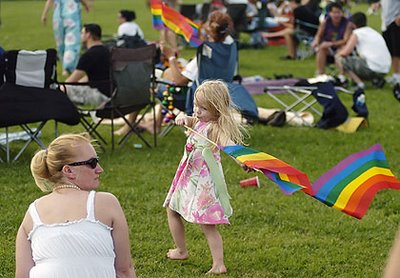
Out In The ParkCHESAPEAKE, VIRGINIA - Sherri Ford caught up with friends Saturday as they settled in on a blanket, chairs and coolers nearby, in the grass at Chesapeake City Park.
Ford, 28, comes every year to Out in the Park - an annual festival celebrating Hampton Roads' gay, lesbian, bisexual and transgender community. This was the festival's debut in Chesapeake; for more than a decade, it had been held at Norfolk's Lakewood Park.
To many, the change was a good thing.
"It's becoming more mainstream," said Ford, who lives in Norfolk.
She added that moving the venue to Chesapeake reflects the way cities in the area are growing with new developments and new residents. So, too, is Hampton Roads' gay community, she said.
"We're not hidden anymore," Michele Barron, 30, chimed in. She's from Newport News and came to the festival with her partner and their son. "This is really a place that is family- friendly - you're able to bring your kids."
Like Barron, several families, couples and friends sat on blankets or on the grass to listen to the day's entertainment. Others checked out the festival's first beer garden as well as 60 vendors - more than in the past, according to Ed Jones, an executive board member of Hampton Roads Pride, which organized the event.
There were booths providing such items as rainbow-colored jewelry, information about St. Mark's Episcopal Church and books from Lambda Rising in Norfolk's Ghent neighborhood.
Members of the Commonwealth Coalition passed out "vote no" literature, too, in reference to a question that will appear on November's ballot, asking voters if they want to amend Virginia's Constitution to ban same-sex marriages. The Commonwealth Coalition is composed of gay rights activists and business and religious organizations.
Opponents say the proposed amendment is discriminatory and could interfere with contracts between unwed heterosexual and same-sex couples dealing with health care, property ownership and child custody.
On Saturday, Franco Ferrandini-Pucci did his part to get the word out, walking through the crowds with a sign that read: "Equal love, equal marriage, equal rights!"
"He's our one-man parade," Jones said.
He usually does something like this at every year's Out in the Park, Ferrandini-Pucci, 71, said. This year, the amendment was on his mind.
"We want you to vote 'no' on all this," he said, pointing.
The festival was the culmination of a week long pride celebration, including events at the Naro Cinema in Norfolk and a cocktail reception for gay, lesbian, bisexual and transgender veterans.
Keynote speaker Rich Merritt took the stage at 2 p.m. to share some of his personal story, which is chronicled in his book, "Secrets of a Gay Marine Porn Star."
Merritt encouraged people to stop searching for role models and to instead be empowered by those around them.
"There's no reason to sit back and whine that we don't have a Rosa Parks when there are heroes all around us," he told the audience. "And there's nothing stopping you from becoming your own hero."
Meanwhile, Betty Perry of Virginia Beach strolled past booths with her friend Carol Bland of Norfolk. It was Perry's first visit to Out in the Park. And it was liberating.
"I've been closeted. But I'm not closeted anymore," said Perry, 68. "It's just nice to be with people where you can just be yourself."
from The Virginia Pilot

Sunday, September 17, 2006

Woman Wins Transgender Bias Case

Danielle CornwellDENVER, COLORADO - A woman who was fired while preparing to undergo sex-change surgery was let go in violation of state anti-discrimination law, the head of Colorado's civil rights agency has ruled.
Advocates praised the ruling, saying it was the first of its kind in Colorado and a sign that society has begun to better understand transgender people.
Danielle Cornwell, 54, claimed in a complaint filed in April with the Civil Rights Division that she was fired in July 2005 because she was a woman and because she had recently told the company she planned to undergo gender-reassignment surgery.
Originally known as David Michael Cornwell, she had realized while working for Intermountain Testing Co. that she was a transgender woman, according to the ruling. She began assuming a feminine appearance, and also told her employer she planned to change her name and dress in women's clothing.
The company, which uses X-rays and other methods to test materials for the construction and manufacturing industries, argued Cornwell was fired because of a decline in business and because she had a low performance rating.
In his Aug. 21 decision, Civil Rights Division Director Wendell Pryor agreed Cornwell was fired because she was a woman said the evidence did not support the company's claims. He said no other employees doing similar work were fired.
"Given this, it appears that the (company's) decision to discharge (Cornwell) was based on her gender - female," Pryor wrote.
Intermountain Testing President Gary Bollerud did not return a call. His attorney, John Husband, declined to comment.
The ruling means Cornwell and representatives of her former employer will meet in October to try to agree on a resolution, her attorney, John Hummel, said Thursday. Cornwell said she would not seek her job back. Hummel said such cases typically are resolved with a cash settlement.
"The well's been poisoned," Cornwell said.
Hummel, who works for the Legal Initiatives Project of the Gay, Lesbian, Bisexual & Transgender Community Center of Colorado, said it was gratifying that the agency did not find the case controversial.
"Maybe that's a sign of progress in society in beginning to understand transgender people more than they had before," he said.
from The Tri-City Herald