skip to main |
skip to sidebar
 FLORIDA - Former U.S. Rep. Mark Foley is using leftover campaign cash to pay for the huge legal bills he's racking up defending himself in the congressional page scandal that led to his resignation.
Foley spent $206,000 in campaign cash on attorneys from November to January, according to recent filings with the Federal Election Commission. That left about $1.7 million in the Florida Republican's campaign account March 31, even after he returned more than $110,000 from donors.
"Many congressmen, when they resign, they keep the money and do good things with it. But paying for your legal bills? I don't think so," said Robert Starr, chairman of the Charlotte County Republican Party.
The FEC has ruled in other cases that such expenditures generally are lawful.
"I got my 500 bucks back. ... I gave him money because I believed in him. It's not that way anymore," Starr said.
Foley's criminal defense attorney, David Roth, declined comment Thursday. A telephone message left with the Washington-based law firm that got all the legal payments from Foley's campaign account was not immediately returned.
Foley resigned from Congress in September after being confronted with sexually explicit Internet communications to male pages who had worked on Capitol Hill. Soon after, he checked himself into an Arizona facility for what his attorneys said was for treatment of "alcoholism and other behavioral problems."
His attorneys at the time announced Foley was gay and alleged he had been molested by a priest as a teenage altar boy. They maintain Foley never had inappropriate sexual contact with minors.
State and federal authorities continue to investigate whether Foley broke any laws through some explicit communications with minors.
from The Associated Press
 FLORIDA - Six months after resigning from Congress, former U.S. Rep. Mark Foley remains under criminal investigation for sexually explicit Internet communications with underage boys but has not been charged, authorities said Wednesday.
"I can't really give any more detail other than to say we're still in the preliminary investigative stance and we are working with state authorities," said Debra Weierman, spokeswoman for the FBI's Washington field office.
Florida authorities announced their own criminal investigation in November but have remained tightlipped on the status since then.
Foley resigned Sept. 29 after being confronted with the lurid messages to male teenage pages who had worked on Capitol Hill.
He checked himself into an Arizona facility on Oct. 1 for what his attorneys said was treatment of "alcoholism and other behavioral problems." At the time, his attorney said Foley was gay, an alcoholic and had been molested by a priest as a teenage altar boy in Florida.
Attorney David Roth maintains Foley never had inappropriate sexual contact with the minors. He has declined further comment on any aspect of the case.
Federal law generally requires a person to meet or attempt to meet a minor for sex for it to be a crime. However, under laws in some states where the Florida Republican communicated with minors, an attempt to seduce the victim might be enough for a criminal case.
Under state law in Florida, where the age of consent is 18, a crime may have been committed if Foley is simply found to have seduced or attempted to seduce a minor using lewd or explicit language.
"It's definitely still an active investigation," Florida Department of Law Enforcement spokeswoman Kristen Perezluha said Wednesday.
Foley emerged publicly in West Palm Beach on Nov. 17 to attend a wake for his father, Edward, who died of cancer, but has rarely been seen in public since.
from The Associated Press
 In a major new development confirming our theory that radical gay activists were behind the Mark Foley scandal, the mysterious source responsible for exposing Foley's behavior has been identified as an employee of the Human Rights Campaign. This is the radical homosexual organization that functions as an adjunct of the national Democratic Party.
Conservative bloggers discovered that the source, who operated stopsexualpredators.com, had used the Internet facilities of the Human Rights Campaign (HRC) to post the Foley emails that found their way into the hands of Brian Ross of ABC news and led to the congressman's resignation. HRC issued a statement saying that when this information came to their attention, "We investigated the matter, determined that HRC resources had been inappropriately used, and let him go. No one at the Human Rights Campaign, other than this individual, had any knowledge of his activities."
One of the board members of the HRC is Jeff Trandahl, the former House clerk who has inside information about the scandal and has testified before the House Ethics Committee. During his "Republican" career on Capitol Hill, Trandahl had contributed financially to the Gay & Lesbian Victory Fund, a group supporting mostly Democrats for public office.
Citing a source in the case, ABC's The Blotter reported that Trandahl had identified Foley and Congressman Jim Kolbe (R-Ariz.) as being among a small number of "problem members" of Congress who "spent too much time socializing with pages, taking them to dinner or sporting events outside of official duties."
All of this means that there was inside information, available to radical gay activists allied with the Democratic Party, which could be used to create scandals for Republican gay members of Congress. Of course, the problem wouldn't have surfaced in the first place if Congressional Republican leaders had not been protecting homosexuals in their ranks. House leaders knew that Foley was a homosexual but permitted him to serve as a co-chair of the House Caucus on Missing and Exploited Children. In the case of Kolbe, who announced that he was a homosexual after being threatened with "outing" by a radical homosexual publication, House leaders still defended him.
Kolbe, who is retiring from Congress, is under investigation by the U.S. Attorney in Phoenix because of a 1996 camping trip he took with two male former pages, both of them 17-years-old. MSNBC reported that "One participant, who requested anonymity, said he was uncomfortable with the attention Kolbe paid to one of the former pages. He was 'creeped out by it,' he said, adding that there was a lot of 'fawning, petting and touching' on the teenager's arms, shoulders and back by Kolbe."
Kolbe's alleged corrupt activities go far beyond inappropriate relationships or contacts of a possible sexual nature with former pages. Associated Press reported that Kolbe was up for the job leading the Global Fund to Fight AIDS, even though he had helped determine its funding as chairman of a House Appropriations subcommittee. AP said, "The committee's bill, approved May 25, included $3.4 billion in global assistance to combat AIDS, tuberculosis and malaria, including $445 million for the U.S. contribution to the Global Fund." This figure, advocated by Kolbe, was over twice the amount requested by the Bush Administration.
So Kolbe padded the bank account of an organization that considered hiring him as its executive director.
from Accuracy In Media / Cliff Kincaid
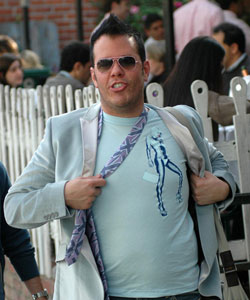 The white-hot center of the celebrity gossip world is currently a back table at a heavily trafficked Coffee Bean & Tea Leaf on Sunset Boulevard, just west of Fairfax. There, Perez Hilton, a slightly pudgy, recently blonded 28-year-old Cuban American blogger, has leveraged his reign as "queen of all media" to become a one-man celebrity outing operation, doing his best to uncloset as many gay celebrities as he can, because, as he sees it, they have forfeited their right to privacy on that point.
"In American culture, a lot of people still think that being gay is bad, and that being gay will hurt your career. I generally don't think that," said Hilton, whose real name is Mario Lavandeira. He began using his made-up Web moniker full time after getting death threats from Clay Aiken fans who didn't appreciate Hilton's calling the singer Clay Gay-kin. (Aiken has denied being gay.)
Styling himself a "gossip gangsta," Hilton picks heroes and villains (Angelina Jolie = good, Jennifer Aniston = bad), elevates obscure figures to fame (the bodaciously endowed British model Jordan) and never tires of ragging on Lindsay Lohan, of whom he delights in posting vulgar photographs.
But it is the absolutely brutal way he demands that gay actors avow their sexuality, coupled with the huge readership of his site, that is something of a departure, even in the rough-and-tumble world of celebrity blogs.
"I am not some safe, cookie cutter, queer-eye-for-the-straight-guy homo," said Hilton, who pings between comedy and gross vulgarity on his site. "I am dangerous. I am gonna push the envelope. I am gonna be who I am: a loud, gay Latino that has opinions and in my own way, subserviently, I am trying to make the world a better place."
It is true that Hilton does not take credit for the recent spate of revelations by the actors Neil Patrick Harris and T.R. Knight and the former 'N Sync band member Lance Bass. But, at least with Bass and Harris, Hilton kept up a drumbeat about their sexual orientation. Some think the relentless attention may have played a part in their decisions. He agreed, up to a point.
"I am never gonna take ownership of someone's coming out — that's their moment, and their decision," Hilton said Tuesday evening, twisting his baseball cap around as he sat at his "desk" in the Coffee Bean with his indispensable laptop and pink Sidekick. "I will say that I may be leading the conversation, and I might grease the wheel and make it easier for them."
Even serious-minded thinkers on the subject do not disagree. "Nowadays, it's the blogs that get it going," said USC professor Larry Gross, author of "Contested Closets: The Politics and Ethics of Outing." "In the previous round of outing in the early '90's, everybody wanted to be first to be second. No one wanted to take the heat for starting it, but the blog phenomenon has changed that by lowering the threshold to the point that other media can't avoid it. What we are now seeing is Outing 2.0"
This year, Hilton practically trilled, "there have been six — well, 5 1/2 if you count Ted Haggard — notable people that have come out as gay or lesbian, by choice or not." In addition to Knight, Harris and Bass, he cites ex-Florida Rep. Mark Foley and a TV actress who has not publicly acknowledged she is gay.
In 2004, Hilton added, there was only one notable gay person who stepped out of the closet: James McGreevey, who resigned as governor of New Jersey when he came out. "It's gone from one to 5 1/2 ," said Hilton. "Wow, wow, wow. That's progress, whether we like it or not."
With more than 2.5 million hits a day on the site, Hilton wields tremendous power. "I don't want to sound full of myself, but if I had not been talking about Lance Bass as much as I was before he came out, there is no way he would have gotten the cover of People magazine. He would have gone about it the traditional way, coming out on the cover of the Advocate, which is read by 70,000 people instead of the 3.4 million who read People every week. So I offered him this silver platter, you could say."
Still, in the arena of true breakthroughs, said Gross, the gay world is still waiting for its Jackie Robinson equivalent, an A-lister who would make it OK for others to come out. In that regard, he said, Hilton's efforts are "salutary, because we are still living in a double-standard world ... where there is something shameful about sexuality. The fact that someone is gay only will become neutral information when it's treated that way, not as a bombshell revelation or a dirty story."
Hilton already operates as though that is the case. He wishes that gay celebrities who don't want to talk about their private lives could just say, "Yes, I am gay and I don't want to talk about my private life."
He does not own a TV or read books and has no Internet at home. He is a voracious consumer of magazines, though, and has a network of trusted friends and tipsters who, he said, have yet to lead him astray.
He starts work around 6:30 a.m., sometimes posting 30 times a day, a far more prodigious output than many fully staffed sites. By sheer energy and personality, his site and he are rapidly evolving into a brand. He is in demand by radio and TV outlets as a celebrity commentator. He recently taught a Learning Annex class, "How to Blog Your Way to Fame and Fortune." ("I inspired myself!" he said.)
Collaborating with the production company World of Wonder, Hilton will star in his own reality show. He is the subject of a four-page layout in December's GQ, will co-host MTV's New Year's Eve special, will appear on the cover of the Advocate next month and was just named to a list of 25 powerful Latinos by the New York Post, which sued him in May 2005 for trademark dilution, among other things, prompting him to rechristen his original website, Pagesixsixsix (it's now called perezhilton .com). "I guess they didn't find the name funny," said Hilton.
Hilton is also smart enough to know that his current good fortune could be fleeting and is working 19 hours a day to make sure it stays. After all, it was only last year that this lower-middle-class, Jesuit-schooled kid from Miami was unemployed, $60,000 in debt, in bankruptcy and deeply depressed. Today, he said, he earns six figures. He has agents, a lawyer, a manager and a public that, despite its craving for the content he provides, can be vicious toward him in comments on his site. Which he loves. "Every time they leave a comment, it's a page view," he said. "I'm laughing all the way to the bank."
He moved to Los Angeles full time in 2002, after graduating from New York University, where he studied acting. While looking in vain for acting gigs, he was hired as a publicist, but didn't like the clients. "The last straw was this 40-year-old single mother who came out with a mermaid bikini calendar. It was her in a mermaid tail, and I was like, 'Oh, my God, this lady is like too old for this. But hey, I was resourceful…. I booked her at Long Beach aquarium!"
He was hired by the Gay and Lesbian Alliance Against Discrimination, overseeing newsletters and annual reports. "I don't think I am their favorite person right now," he said.
A spokesman for GLAAD was diplomatic. "Media speculation about a celebrity's orientation is not something we support and it can be problematic," said Damon Romine. "Whether you are a celebrity or not, coming out is ultimately a personal process."
After Hilton left GLAAD, he freelanced for gay publications and found work at the Star briefly before being fired. Combining his three failed occupations — actor, publicist, journalist — he has struck gold.
"Next year will be one of two things," he said. "I am gonna fall or it'll be even bigger and better and crazier than this amazing year has been. I am hoping bigger and better, but I'm prepared for the other one too."
from The Los Angeles Times

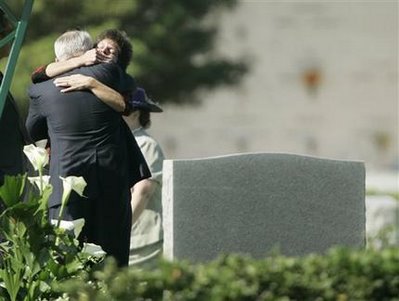 ROYAL PALM BEACH, FLORIDA - Former U.S. Rep. Mark Foley sobbed Saturday as he delivered a eulogy at his father's graveside, alluding to his resignation from Congress amid an Internet sex scandal as disheartening to his dad.
''I disappointed him so much,'' Foley said crying, while surrounded by about 50 friends and family. ``But he was so good of a man.''
Edward Foley, a longtime educator, died Tuesday of complications from cancer. He was 85.
The father and son had a close relationship over the years, though in the last weeks of Edward Foley's life, the former congressman had been in a secluded Arizona treatment facility.
He checked himself in Oct. 1 for what his attorneys said was for treatment of ''alcoholism and other behavioral problems.'' Since then, he hadn't been seen publicly until he returned to Florida to attend his father's wake Friday night.
Foley resigned from Congress on Sept. 29 after being confronted with sexually explicit computer messages he sent to male teenage pages who had worked on Capitol Hill.
Edward Foley would often campaign with his son until he was diagnosed with cancer in 2003. Mark Foley then abandoned a bid for the U.S. Senate, saying he needed to be with his family. The decision to bow out of the race also came shortly after an alternative newspaper reported that Mark Foley was gay. Foley denounced the allegations as rumors spread by his political opponents, but he refused to answer questions about whether he was homosexual.
''It's just been a real hard time,'' Foley told The Associated Press on Friday.
Soon after Foley entered treatment, his attorneys announced that he was gay, suffered from alcoholism and had been molested by a priest as a teenage altar boy .
The Rev. Anthony Mercieca, who has retired to Malta, has admitted having inappropriate encounters with Foley, including massaging him in the nude and skinny-dipping together, but he denies having sex with Foley. Church officials are investigating whether Mercieca had inappropriate contact with others.
Florida authorities have opened a criminal investigation into whether Foley broke any laws related to his lurid communications with the teens. Federal authorities are also investigating.
Foley's attorneys have said he never had inappropriate sexual contact with a minor. Meanwhile, a House ethics committee is looking into whether senior GOP officials hid what they knew about the computer messages.
from The Miami Herald
 WEST PALM BEACH, FLORIDA - Florida authorities have opened a criminal investigation into the sexually explicit computer messages that former Rep. Mark Foley sent to male congressional pages.
"It was a preliminary inquiry before, but we found the basis to open up a criminal investigation," Kristen Perezluha, a spokeswoman for the Florida Department of Law Enforcement, said Thursday. She would not elaborate.
The FBI is investigating whether Foley broke federal laws, and the House Ethics Committee is looking into whether senior GOP officials hid what they knew about the messages.
Foley, a Republican, resigned Sept. 29 after being confronted with the lurid communications. His attorney, David Roth, has said Foley never had inappropriate sexual contact with minors.
Roth declined to comment Thursday on the criminal investigation.
Florida law prohibits seducing or attempting to seduce a minor. However, authorities have said the term "seduce" is open to interpretation.
Foley has returned to Florida to attend his father's funeral, set for Saturday, after spending more than a month in an Arizona rehabilitation facility for alcoholism, Roth said. Edward Foley died Tuesday of cancer.
Foley entered the treatment facility Oct. 1, shortly before his attorneys announced he was gay, an alcoholic and had been molested by a priest as a teenage altar boy in Florida.
The Rev. Anthony Mercieca, who has retired to Malta, has admitted having inappropriate encounters with Foley, including massaging him in the nude and skinny-dipping together. He denies having sex with Foley.
Foley has not been seen publicly since shortly after his resignation.
from The Los Angeles Times
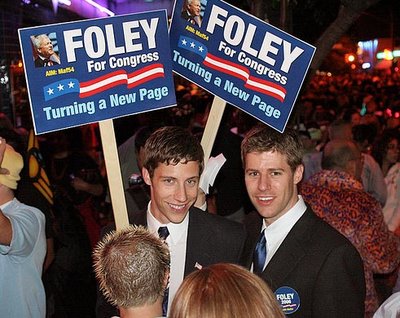 WEST PALM BEACH, FLORIDA - Ed Foley, a longtime educator and father of former U.S. Rep. Mark Foley, has died. He was 85.
Foley, who had been ill with cancer, died Tuesday, said Gale Schiffman, co-owner of Quattlebaum-Holleman-Burse Funeral Home.
A Massachusetts native, Edward Foley moved to Florida in the 1950s. He was a teacher and principal who frequently campaigned on his son's behalf.
The younger Foley gained national attention this fall when, in the waning weeks of his campaign for re-election, the congressman was confronted with sexually explicit messages he sent to teenage pages who worked on Capitol Hill.
Mark Foley resigned Sept. 29. State and federal authorities are investigating whether he broke any laws.
Mark Foley abandoned a bid for the U.S. Senate in 2003 after his father was diagnosed with cancer. His decision to bow out of the race also came shortly after an alternative newspaper reported that Mark Foley was gay. Foley denounced the allegations as rumors spread by his political opponents, but he refused to answer questions about whether he was homosexual.
He has been in a treatment center in Arizona for alcoholism since Oct. 1, according to his attorneys.
from The Associated Press
 We're all familiar with the headlines involving homosexuality. The names of Jim McGreevey, Mark Foley and now Ted Haggard have become known throughout America because of admitted or alleged homosexual "indiscretions." We have not heard as much about their families. That's where I come in. I understand something of what their families are going through because I've been there.
We all understand that reputations were ruined, careers lost and families hurt by these scandals. Apparently what we don't understand is that we are all part of turning these disclosures into scandals. And our clucking and condemnation after they emerge, while a contributing factor, isn't where our real culpability lies. The root of the problem is in our denial that gays and lesbians are as worthy and unworthy, flawed and gifted, as heterosexuals. The root belief that homosexuals are "less than" the rest of us stretches long and deep in this society.
Our condemnatory attitudes began in the latter part of the Middle Ages. Until then the Christian church in Western Europe, and thus the general culture, had largely tolerated or ignored homosexual acts. But everything changed when Thomas Aquinas and other religious writers labeled not only homosexual acts but all non-procreative sexual behavior "unnatural." The Roman Catholic Church continues to promote this idea today, even though most critical thinkers appreciate the relational bonding, tension release and joyous pleasure that sexuality affords along with the possibility of procreation. Of course any practice of sexuality that harms, takes advantage of or demeans another person is wrong, no matter who is involved. Nonetheless, instead of dealing with this and other related issues in a straightforward way, many join the church in simply rejecting gays and lesbians.
Let me hasten to say that I do not intend to single out the Roman Catholic Church for criticism. For several years my own denomination, the United Methodists, has presented invitational ads on national television proclaiming the church to be one of "open hearts, open minds, open doors" while declaring in its Book of Discipline that "the practice of homosexuality is incompatible with Christian teaching." Thus the United Methodist Church, like many others, remains deeply divided over this issue.
It took the Catholics 171 years to accept Copernicus's insight that Earth revolves around the sun. Today too many people are hurting and too much damage is being done to continue to wait for any church to step up and admit it is wrong about its condemnation of the "practice" of homosexuality. It's time we did our own critical thinking and rejected outdated science and theology. For, ironically, the anguish of our rejection of gays and lesbians, as horrible as it is for them, affects us all.
I know this because I have suffered deeply as a result of America's prevailing views about homosexuality. You have as well. I was married to a closeted gay man for 15 years, and we had three children before the truth of his sexual orientation emerged. The emotional devastation of that revelation and our subsequent divorce has been profound for me, my children, my former husband, our extended family and our friends.
I was fortunate to be able to move forward with my life instead of remaining, as one friend recently put it, "a puddle of violated humanity." I remarried, became an ordained clergywoman and served the church for 25 years as a pastor, district superintendent and dean of the cabinet of the Northern Illinois Conference of the United Methodist Church. Broken relationships with family have been largely, if not totally, healed.
But many people are not as fortunate. They, and our society at large, miss out on the fullness of life that is tragically denied to so many because the rest of us don't want to deal fairly and fully with such a difficult and embarrassing subject. Families are torn apart, careers ruined, gifts and graces underutilized, and lives destroyed. Thus, ironically, the anguish that gays and lesbians suffer because of their rejection isn't visited just upon them, as horrible as that is. It affects us all.
This Election Day the citizens of our country demanded change by voting for different leadership in Congress. Now I would urge us all to seek actively to inform ourselves and change our attitudes about gays and lesbians. For only in this way will we begin to address the real problems that our condemnation has visited upon them, upon those who love them and, indeed, upon us all.
from The Washington Post / Ermalou Roller
 The executive director of an organization that offers support to members and to the families of members of the "ex-gay" community -- former homosexuals and those struggling with unwanted same-sex attraction -- has a unique perspective on the Mark Foley scandal. While reproaches and recriminations abound in the media, she says someone needs to offer the disgraced former Congressman and others like him a message of hope and truth.
Regina Griggs of the group Parents and Friends of Ex-Gays and Gays, or PFOX, says it is not enough for the public discourse to ignore Foley's homosexuality or to affirm its existence while condemning his immoral and possibly criminal actions -- specifically his alleged sending of sexually suggestive e-mails to underage boys in the Congressional Page Program. But even getting to the bottom of a criminal investigation of the allegations against Foley, she suggests, would not adequately address his situation.
"So why are we not providing hope? Why are we not publishing the facts?" Griggs wants know. And why is no one really telling the clear though politically incorrect truth -- about the link between his sexual initiation and his sexual orientation -- to "people like Mr. Foley, who decided that he was gay based on something that took place during his teen years?" she asks.
This scandal is an opportunity to spotlight two truths, the PFOX official asserts. One, she says, is that homosexuality is often the result of molestation of children and youths; and the other is that many of those victims have still managed to come out of the homosexual lifestyle.
"My concern is that people who are buying into [the notion of] 'born gay, cannot change' do not realize that there is hope and there is healing available," Griggs notes. It is important to give voice to these facts, she contends, because the message of recovery from homosexuality is being silenced by homosexual activists, who are instead directing youth that have been molested into a homosexual identity.
"If we want to stop this type of behavior, and if we don't want to see it reproduced, then we have to begin to provide information for all men and women," the ex-gay outreach spokeswoman says. The victims caught in this tragic cycle and other homosexuals "have to know there's an answer," she insists.
The teenage molestation incident that former Congressman Foley says introduced him to homosexuality is unfortunately a very common phenomenon, Griggs points out. And it is a graphic example of why treatment to keep sexual disorientation or gender mis-identity from occurring is so vital. "The truth is out there," she says; "it's time to make it known."
from Agape Press
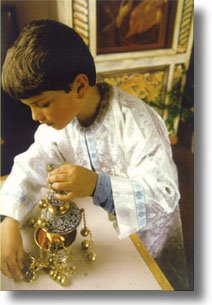 MIAMI, FLORIDA - Another former altar boy says he was sexually abused in the 1970s by the same retired Catholic priest who acknowledged fondling former Rep. Mark Foley when Foley was a teenager, the man's attorney said Wednesday.
The new allegations against the Rev. Anthony Mercieca were made by a man who lived in North Miami and was an altar boy at St. James Catholic Church, where Mercieca worked, attorney Jeffrey Herman said.
Herman said he planned to file a lawsuit Wednesday against the Archdiocese of Miami. His client, now 40 and identified in the lawsuit only as John Doe No. 26, says Mercieca abused him when he was about 12 years old.
"He had been thinking about it before Foley came forward, and then when Foley came out and the church encouraged other victims to come forward, he decided to come forward," Herman said.
The man said "all of my nightmares came back" when Mercieca's picture appeared on the news last week amid Foley's claims that the priest had molested him. Foley had resigned amid accusations that he sent sexually explicit messages to teenage boys who had worked on Capitol Hill.
Mercieca, 69, now lives on the Maltese island of Gozo in the Mediterranean. No one answered the phone at his home Wednesday. His lawyer, Alfred Grech, did not return calls to his cell phone.
Archdiocese of Miami spokeswoman Mary Ross Agosta, asked about the latest allegations, said: "Any of this type of behavior by Father Mercieca was unknown to the archdiocese and we had absolutely no information to indicate that the father did or would engage in any type of inappropriate or abusive behavior."
The Miami Archdiocese barred Mercieca from all church work as it investigates Foley's claim that the clergyman molested him when Foley was an altar boy at Sacred Heart Catholic Church in Lake Worth in 1967.
Mercieca is now retired and does not serve in any parish, but he regularly celebrates Mass and hears confession in the cathedral on Gozo, according to the Archdiocese of Malta.
In multiple interviews last week, Mercieca denied having sexual intercourse with Foley, but he did acknowledge being nude with him when Foley was a boy.
Mercieca also denied having sex with any underage children.
Herman said his client and Mercieca took a bicycle ride together one day after altar boy practice and then returned to the church where the abuse occurred.
"It was fondling and he performed oral sex on the boy," Herman said. "He attempted on another occasion following altar boy practice, but the boy declined to go on this bike ride and he never went back to the church after that."
Mercieca served as an assistant pastor at the church from 1975 to 1985, according to church records.
Foley resigned from Congress last month after he was confronted with sexually explicit computer communications he had sent to male teenage pages who worked on Capitol Hill. He has since entered a 30-day rehabilitation program for alcoholism at the Sierra Tucson treatment center in Catalina, Ariz., near Tucson, according to his attorneys.
from The San Jose Mercury News
 Eight years ago, when Bill Clinton was caught lying about his affair with a White House intern, Mark Foley voted to impeach him. "It's vile," said the congressman. "It's more sad than anything else, to see someone with such potential throw it all down the drain because of a sexual addiction."
As we say on the Internet: LOL. We now know that Clinton and Foley were on different teams, but not in the way Foley pretended. And the irony only begins there. The two men have played similar roles, not only in their reckless personal lives but in the cultural revolutions of their respective decades. Clinton introduced us to the ambiguities of sex. Foley is introducing us to the wilder ambiguities of cybersex.
In his 1998 deposition , Clinton was asked whether he had ever "had sexual relations with Monica Lewinsky, as that term is defined in Deposition Exhibit 1." The definition referred to "contact" with the other person's private parts. Clinton said he hadn't. Seven months later, when he admitted that Lewinsky had given him more than pizza , Clinton argued that this didn't meet the definition because "if the deponent is the person who has oral sex performed on him," the contact was only "with the lips of another person."
That wasn't even Clinton's best line. During the deposition, his lawyer said that "there is absolutely no sex of any kind in any manner, shape or form" between Clinton and Lewinsky. When Clinton was asked later whether that statement had been false, he opined , "It depends on what the meaning of the word 'is' is."
Two months after offering those rationalizations, Clinton signed the Protection of Children from Sexual Predators Act of 1998. The measure, cosponsored by Foley, extended the prohibition on enticing minors to cover "sexual activity," not just a "sexual act." It also added special penalties for using a computer. "There has been an explosion in the use of the Internet in the United States, further placing our Nation's children at risk of harm and exploitation at the hands of predators," the legislation warned.
But the Internet revolution turned out to be kinkier than the sexual revolution. The sexual revolution changed how people touched each other. The Internet revolution took sex beyond touch. A degenerate can reach out and mess up your kid without even setting foot in your state. Is that abuse? It depends on what the meaning of "abuse" is.
Computers didn't invent non-contact sex. That has been around since the telephone. Kenneth Starr's "Table of Contacts between Monica Lewinsky and the President," for instance, lists 17 incidents of phone sex and nine incidents of "in-person" sex. Most of the intern's lip contact was with a receiver, and not the kind you can depose. But phone sex is risky. Someone might hear you. If you're calling a minor, her parents might pick up the phone or eavesdrop.
That's where computers come in. Clinton's romp with Lewinsky during a phone call with lawmakers was "just sad," Foley told reporters at the time. "It's unbelievable that he could behave so carelessly in that setting." Foley appears to have taken more care. According to the message trail that has come out publicly, he doesn't seem to have had sex in person, or over the phone. He did it over the Internet . Boys chatting with Foley were interrupted by their mothers , but the chats were inaudible, so the moms never knew what was going on. "Hope she didn't see anything," Foley told one boy. "No," said the kid. "She is computer dumb." "Good. Haha," replied the congressman.
Every state outlaws using the Internet to solicit sex with minors. But if you postpone physical sex until your quarry is 18, you can skirt these laws. Until that day, the sex has to stay online. Like Clinton, Foley appears to have carved out a kind of sex that in his mind wasn't officially sex. For Clinton, it was oral; for Foley, it was online. He'd pick you out as a page. He'd befriend you by e-mail. He'd groom you with instant messages. He'd find out your birthday and when you would turn 18.
Some states pursue adults with underage sex in mind into cyberspace and outlaw dirty messages. Georgia, for instance, forbids any "Internet contact" with minors involving "explicit verbal descriptions or narrative accounts of sexually explicit nudity" or even of "sexual excitement." The recipient doesn't have to be a minor. He can be anyone "believed . . . to be a child residing in this state." Someone could be charged under this law even if he never went to Georgia or wrote to anyone there. All you would have to do is meet him in a chat room, pose as an Atlanta teenager and wait for him to say something gross.
If a pervert won't act on his words, you can criminalize the words. If he won't utter them, you can prosecute him for writing them. If he won't come to your state, you can go get him. If he has no victim, you can invent one. This is no joke. In almost every state, laws specify that you can be convicted of an Internet sex offense against a child even if you contact no child and commit no physical crime. In fact, the most recently analyzed data, published by the National Center for Missing and Exploited Children, suggest that more people are arrested on suspicion of using the Internet to solicit what turn out to be cops posing as kids than for using it to initiate relationships with real kids. The unnatural has been surpassed by the artificial.
Cybersex is only getting weirder. Most Canadian college students surveyed by a dating Web site say they've already had sex via instant messages. By year's end, more than 100 million people will be playing online games. Fifteen million webcams are in use; hundreds can be viewed for a fee, and many are pornographic. You can even interact with a "virtual girlfriend" on your cellphone. It's a creepy world of imaginary meetings and deeds. The only thing creepier, perhaps, is to prosecute them like the real thing.
from The Washington Post
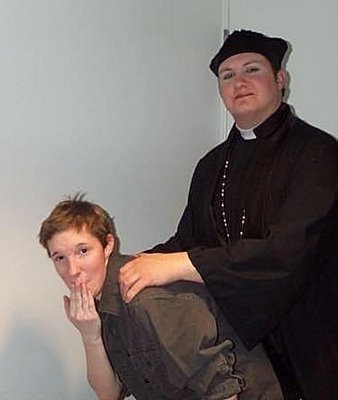 The Archdiocese of Miami on Friday barred the Rev. Anthony Mercieca from functioning as a priest anywhere in the world after confirming that he was the clergyman who Mark Foley said molested him in the 1960’s.
Father Mercieca, who now lives in Malta, can no longer publicly celebrate Mass, administer the sacraments or wear priestly clothes, said Mary Ross Agosta, a diocesan spokeswoman.
Ms. Agosta apologized to Mr. Foley in a statement and described as repugnant Father Mercieca’s intimate contact with him, which the priest disclosed to a Florida newspaper this week. Father Mercieca, 69, worked in South Florida for almost 40 years and remains under the auspices of the archdiocese.
“Such behavior is morally reprehensible, canonically criminal and inexcusable,” Ms. Agosta said.
Mr. Foley, 52, resigned from the House of Representatives last month after the release of sexually explicit messages he had sent to teenage Congressional pages. Soon after, his lawyer announced that Mr. Foley is gay, had gone into treatment for alcoholism and had been molested by a clergyman when he was 13 to 15.
“An apology is due to Mr. Foley for the hurt he has experienced,” Ms. Agosta said.
So far, she said, no one else had reported sexual misconduct by Father Mercieca. He worked in at least eight parishes in South Florida since 1966, most recently at Blessed Trinity Catholic Church in Miami Springs from 1993 to 2003. Ms. Agosta said he left Florida to retire.
“There were absolutely no other problems,” she said in an interview.
Ms. Agosta said the Archdiocese of Miami had begun an internal investigation that could result in further sanctions against Father Mercieca. A spokesman for the archbishop of Malta said an investigation was under way there, too.
Though retired, Father Mercieca was still saying Mass every morning at a cathedral on Gozo, the Maltese island where he was raised and now lives with his brother, also a priest.
The Survivors Network of Those Abused by Priests, an advocacy group, said that both diocesan actions were insufficient and that Father Mercieca should be put in a secure treatment facility while the police investigated.
The Herald-Tribune of Sarasota, Fla., reported Thursday that Father Mercieca said he had skinny-dipped and lounged naked in saunas with the young Mr. Foley, massaged him and roomed with him naked on overnight trips. He said that once, on tranquilizers, he might have gone further with Mr. Foley but could not recall details.
Father Mercieca repeated the claims in interviews with other news outlets, but also said his relationship with Mr. Foley was not sexual.
The survivors group has urged Mr. Foley to press charges, but the statute of limitations has probably expired. His civil lawyer, Gerald Richman, said Friday that he had no idea whether Mr. Foley would pursue the matter.
Mr. Richman identified Father Mercieca to Palm Beach County prosecutors this week as Mr. Foley’s molester. Prosecutors shared the information with the archdiocese, but said they would do nothing more unless other victims emerged.
Ms. Agosta said the archdiocese, which includes Broward, Miami-Dade and Monroe Counties, would encourage any other victims to come forward by asking every parish to make an announcement about Father Mercieca.
from The Amherst Times
 SARASOTA, FLORIDA - A Roman Catholic priest said he had an inappropriate two-year relationship with former Rep. Mark Foley in the 1960s that included massaging the boy in the nude, but he did not specifically remember having sex, a newspaper reported Thursday.
The Rev. Anthony Mercieca, 72, described several encounters that he said Foley might perceive as sexually inappropriate, the Sarasota Herald-Tribune reported. They include massaging Foley while the boy was naked, skinny-dipping together at a secluded lake in Lake Worth and being nude in the same room on overnight trips.
Mercieca said there was one night when he was in a drug-induced stupor and there was an incident but he couldn't clearly remember, the newspaper reported.
"I have to confess, I was going through a nervous breakdown," the newspaper reported Mercieca as saying from his home on the island of Gozo, south of Italy. "I was taking pills tranquilizers. I used to take them all the time. They affected my mind a little bit."
Mercieca could not immediately be located for comment Thursday by The Associated Press.
Foley resigned from Congress last month after his sexually explicit e-mails to young male pages surfaced.
His lawyer said shortly after his resignation that Foley was an alcoholic, gay and had been molested as a boy by a "clergyman." Foley's civil lawyer, Gerald Richman, said the alleged abuser was a Catholic priest whose name he shared with state prosecutors on Wednesday.
Richman did not return phone messaged left Thursday by The Associated Press. Foley's criminal defense lawyer David Roth declined to comment.
Earlier this month, Roth said: "Mark does not blame the trauma he sustained as a young adolescent for his totally inappropriate" e-mails and instant messages. "He continues to offer no excuse whatsoever for his conduct."
Mercieca had worked at Sacred Heart Catholic Church in Lake Worth in 1967, according to church records. Foley would have been 13 at the time.
The state attorney's office in West Palm Beach did not immediately return a telephone message Thursday. A phone for the Archdiocese of Miami wasn't accepting new messages because its voice mail box was full.
Mercieca, 72, said he and Foley became fast friends when he moved to Florida from Brazil and "loved each other like brothers," the newspaper reported.
Mercieca said he taught Foley "some wrong things" related to sex, though he wouldn't specify what he meant, the newspaper said. It reported the priest said that at the time, he considered the relationship innocent, but he now says he could see how his actions could be called inappropriate.
Mercieca said although Foley plans to "expose him to the world," he still has "great memories of our trips," the newspaper reported.
"I wish him well," Mercieca said. "Let bygones be bygones."
Mercieca was adamant that his encounter with Foley was an aberration, and that the Catholic Church never had to send him for counseling during his 38 years in the priesthood in Florida, according to the newspaper.
"I have been in many parishes, and I have never been" accused, he said.
A Web site for the Diocese of Gozo lists Mercieca as one of its priests. Joseph Calleja, a priest with the diocese, said Mercieca is still an active priest but that he lives at his own home. Gozo, a Mediterranean island, is part of the Republic of Malta.
from ABC News
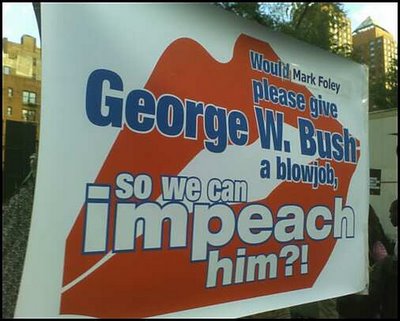 WASHINGTON - The White House yesterday brushed off insinuations it stiffed Mark Foley by not inviting the gay Republican to events with President Bush in Florida two years ago.
"We don't know anything about it, and it sounds pretty silly," said Bush spokesman Tony Snow, sarcastically referring to the disgraced former congressman as "poor guy."
Foley resigned late last month over sexually suggestive Internet chats with underage male pages. But long before the scandal broke, it was an open secret on Capitol Hill that he was homosexual - which didn't sit well with the Bush morality agenda.
In addition to the Foley scandal, Team Bush was coping with another GOP problem by calling on Rep. Bob Ney (R-Ohio) to resign over his role in the Jack Abramoff influence-peddling scandal.
Though several GOP staffers have pleaded guilty in the Abramoff debacle, Ney yesterday became the first sitting lawmaker to admit his role, pleading guilty to conspiracy and making false statements. He faces up to 10 years in prison and could be expelled from Congress if he chooses not to resign.
Foley didn't gripe to Bush directly that he felt left out. Instead, he complained to the President's brother, Florida Gov. Jeb Bush, according to e-mails obtained by the Palm Beach Post.
The newspaper reported that Foley wrote to Gov. Bush on Sept. 29, 2004, "Have I done something to offend the White House ... I am always getting the shaft ... they came to [Fort Pierce] ... weeks ago and said I was not allowed to attend ... yet [GOP state Rep. Joe Negron] ... is there ...
"Tomorrow [the President] is in Martin County and I am told I am not allowed to be there either. I can't quite figure what I have done but this is a continuing pattern of slights ... I have constantly put the President in the best possible light on everything from [Haiti] ... to hurricanes ... sorry to trouble you ... and I wouldn't if this wasn't so frequent ...," the e-mail to Jeb Bush read.
Gov. Bush responded the same day, saying in an e-mail to Foley, "I will try to help. I know it is nothing you have done. Promise. I think it relates to debate prep time. Jeb."
Snow said there was no effort to ban Foley from events. "We know for a fact that the President was in the state quite often last year - hurricanes and other things - and Congressman Foley was there. He's been at the White House a bunch of times," he said.
from The New York Daily News
 As the gay, lesbian, bisexual and transgendered community celebrates today's National Coming Out Day, the occasion comes at a time when seven out of 10 straight adults in the U.S. say they know someone who is gay, according to a recent poll.
It also coincides with turmoil in Washington, D.C., centered around former Rep. Mark Foley, R-Fla., who announced he is gay after it was discovered that he had inappropriate e-mail contact with underage congressional pages.
"Given the recent scandal in Washington, it's particularly important that people celebrate Coming Out Day and really honor people who are living honestly and openly," said the Human Rights Campaign's Mark Shields, director of the grass-roots organization's National Coming Out Project.
"It's particularly important that GLBT people and straight people who care about GLBT people talk about who they are and put a human face on the real community."
National Coming Out Day - first held on Oct. 11, 1988 - is designed to give the gays and lesbians the opportunity to "come out" to others about their sexuality and to raise the profile of the GLBT community.
Los Angeles County, which has a population of about 14 million people, has a GLBT
population that is estimated to be as high as 1.4 million, according to Darrel Cummings, chief of staff for the Los Angeles Gay and Lesbian Center.
"Los Angeles has made tremendous gains over the years and it is seen as a GLBT friendly environment," Cummings said. "But that doesn't mean that there is not tremendous homophobia that continues to exist within the boundaries of L.A. County.
"That's why coming out continues to be the most powerful political act that our community can take. When we do that, we humanize who we are to our families, to our co-workers, to our teachers and everyone we come in contact with."
An online survey of just under 3,000 adults - conducted by Harris Interactive and released this week - showed that of the 324 respondents who identified themselves as GLBT, 83 percent consider themselves out.
Some 92 percent said they were out to close friends, followed by 78 percent to their parents, 68 percent to other relatives, 68 percent to acquaintances and 66 percent to co-workers and colleagues.
Former Los Angeles Dodger Billy Bean, who was closeted throughout his professional baseball career, said Tuesday that people need to be able to come out in their own time.
"I think Coming Out Day is more about we as a group vocalizing our mass positive experience of being out," said Bean, who came out after he retired and wrote the best-selling memoir "Going My Own Way."
"None of us start at the same place and time," Bean said. "When I was in a position emotionally to make it happen, there was such a relief in living honestly and being able to give my family and friends and people I care about the opportunity to know me completely. I just became so much closer to them. As time went by, I even got closer to the guys I played baseball with."
"It's about showing people that you can live a life that is complete and full and honest in an open way."
from The Los Angeles Daily News / Greg Hernandez
 Let's deal with the circumstance that dare not speak its name: How much of the Mark Foley scandal's impact is due to the fact that he's a gay man who preyed on young boys?
The basic story line — powerful man exploits children — would be the same if Foley were straight and underage girls had been the subject of his lurid attentions. But would the intensity of the scandal be the same? Would there be all this unseemly finger-pointing and hand-washing among the House leadership? Would Dennis Hastert be fighting to keep his job, would Christian conservatives be so apoplectic, would the whole Republican Party look as if it were on the verge of a nervous breakdown?
I doubt it. There would still be a scandal, but I think Foley's now-acknowledged homosexuality was crucial in turning a crisis for the party into a potential catastrophe. In a perfect world that wouldn't be the case, but you might have noticed there's not a lot of perfection in Washington these days.
It's tempting to put it all down to hypocrisy. The Republican Party has gone to such lengths to demonize homosexuality that it must pain the leadership to reveal that such a thing as a gay Republican congressman could even exist. The party has stigmatized gay people as "them," not "us" — as a class of people whose "lifestyle" is unsavory and whose committed relationships must never be recognized, lest the republic instantly crumble to dust.
There had been warning signs about Foley's enthusiastic interest in young male pages for years, and the House leadership's inaction is just about impossible to explain — either they ignored the situation, which would be an act of stunning cynicism, or they genuinely didn't know about it, which would suggest woeful incompetence. Not an attractive choice of stories to tell for a party that preaches so much about moral standards and personal responsibility.
Still, I don't think hypocrisy alone is enough to explain why the Foley mess is such a big deal. I think it goes deeper.
One of the central tenets of anti-homosexual doctrine is the notion of "recruitment" — that adult gay people lure young people into homosexuality as a way of increasing their numbers. The most extreme anti-gay activists perceive a full-fledged conspiracy. The Traditional Values Coalition, a group whose homophobia can only be called rabid, goes so far as to claim that after being enticed into sexual acts, the "young 'initiates' into the strange world of homosexuality are to be trained to reject the moral beliefs of their parents."
This is complete bunk, of course — most new research has tended to support the idea that homosexuality is more a matter of nature than nurture, and in any event the notion of an organized "recruitment" drive is far beyond ridiculous.
There are people, though, who are not consciously bigoted against gay people but who find homosexuality difficult to comprehend. There aren't many things more primal and specific, after all, than an individual's sexual desires. For some people who have no base of knowledge about gayness — and, often, whose pastors routinely denounce homosexuality from the pulpit as a sin — the basic idea of recruitment, without all the paranoid conspiracy trappings, seems to explain the inexplicable.
Foley's lawyer explained the former congressman's behavior by saying that Foley was drunk and, by the way, had been molested by a clergyman when he was a child. Was he laying the foundation for a possible legal defense? Or does Mark Foley, until last week still closeted at age 52, actually believe that's why he's gay?
In any event, the recruitment myth helps explain why social conservatives, who make up perhaps the most loyal and energetic segment of the Republican Party's base, are so up in arms. And that outrage, in turn, helps explain why the party has been so frantic all week, so uncharacteristically slow to come up with a game plan for responding to the scandal. Social conservatives were already grumbling that the Republicans talk a good game but never get around to addressing their core issues. Now comes this.
In pre-feminist times, people thought of young girls as particularly delicate and vulnerable. We worried about their being compromised or corrupted by older men. It's fascinating that much of today's America seems to be more viscerally worried about young boys.
The Decatur Daily / Eugene Robinson
 WASHINGTON - It was on a Wednesday night in July 2001 that then-Rep. Mark Foley brought the U.S. House to a screeching halt on a gay-rights issue.
The issue was whether faith-based initiatives should be exempt from local ordinances, such as those in Palm Beach County and West Palm Beach, that prohibit hiring discrimination based on race, gender or sexual orientation.
Foley opposed the proposed exemption and led a rump revolt of moderate Republicans that delayed the measure for more than a day, though ultimately it was unsuccessful.
Although it was widely seen as a gay issue, the Fort Pierce Republican portrayed it as a fight over local and state anti-discrimination laws. It was typical of how Foley sought to publicly obscure his sexual orientation.
Until his lawyer said this week that Foley was gay, he had never publicly acknowledged it. That acknowledgment came four days after he resigned from Congress after being confronted with sexually explicit electronic messages that he had exchanged with former congressional pages.
During his dozen years in Congress, Foley championed gay rights, with one notable exception.
In 1996, he voted for the Defense of Marriage Act, a law that defined marriage as between two people of opposite sex and that said states did not have to recognize gay marriages from other states.
The gay community was outraged, and many within the community called for Foley to be outed in the media.
"Most of the anger from gay people who know Mark came when he voted for the Defense of Marriage Act," said Eric Johnson, the openly gay chief of staff for U.S. Rep. Robert Wexler, D-Delray Beach. "They said, 'You're a huge hypocrite.' "
Foley defended his vote as one for states' rights, not against gays.
Former Foley staffers, who spoke on condition of anonymity, said the Roman Catholic-raised Foley believed marriage was a religious institution involving a man and a woman.
"In Mark's mind, the way it was explained was marriage is a religious institution more than it was a legal definition," one former staffer said. "He never wanted to meddle in religious institutions."
Foley also believed marriage laws were a state responsibility and that federal legislation should not supersede the right of states to determine which marriages they would recognize, the aides said.
"You tell me if Bill Clinton is anti-gay. If he is, how could he sign it?" a former Foley aide said, referring to the Defense of Marriage Act. Clinton signed the measure into law in September 1996.
On other issues, Foley pushed legislation supported by the gay community to expand health-care benefits for gay partners, remove discrimination against gays in the workplace, increase federal spending on AIDS and include in federal hate-crimes law crimes against people because of their sexual orientation.
He also voted against the proposed Federal Marriage Amendment, which would have amended the Constitution to define marriage as between a man and a woman and to deny marital legal benefits to same-sex couples.
One former aide described the difference between Foley's votes for the Defense of Marriage Act and against the Federal Marriage Amendment as a vote to uphold states' rights in the first instance and against altering the Constitution in the second.
While he did not publicize it, Foley was ranked as one of the top Republicans on biennial congressional scorecards issued by the Human Rights Campaign, the nation's largest organization dedicated to "gay, lesbian, bisexual and transgender equality," according to its Web site.
For the 108th Congress (2003-04), Foley received a score of 88 percent, tied for the highest score among the Florida delegation. During that session, he co-sponsored or voted for seven of the eight legislative measures identified by the campaign as important to the gay community. By comparison, 13 of the delegation's 18 Republicans scored zero.
In the previous Congress (2001-02), the campaign gave Foley positive marks on five of the six issues it scored. The Human Rights Campaign's political action committee recognized his support on gay issues by contributing $27,000 to him since the 2000 election cycle.
"In general, we think he's taken the right positions, not just for the gay community but for the country," said Roberta Sklar, spokeswoman for the National Gay and Lesbian Task Force. "He's a moderate Republican who has generally voted for fairness and equality."
Yet Foley hid his sexual orientation from voters and remained a Republican despite numerous anti-gay positions taken by GOP leaders who used gay marriage and gay rights as political red meat.
In 2003, he was gearing up to run for the U.S. Senate when the weekly New Times reported that he was gay. Foley called a telephone news conference to say he would not discuss his sexuality. A few months later he dropped out of the race, citing concerns about his father's bout with cancer.
Despite the anti-gay stances taken by many GOP leaders, there is a strong gay community within the Republican Party.
Patrick Sammon, executive vice president of the gay Log Cabin Republicans, said many of its members believe in core GOP issues such as national security, personal responsibility, limited government and low taxes.
"Yet at the same time, I'm working to make the Republican Party more inclusive and tolerant of gay and lesbian issues," Sammon said. "Gay and lesbian equality will be impossible to achieve without Republican voters. Clearly, the Republican Party is not where it needs to be on issues related to gay rights."
A former board member of the Lesbian and Gay Congressional Staff Association, who asked not to be identified, said that for many gay Republicans, it is "almost like a religion" in that people are born into a family in which the parents and grandparents also were Republicans.
A former Foley aide noted that the congressman, who switched from the Democratic Party early in his political career, was a Republican long before gay issues became a rhetorical hot button in the past few years.
from The Palm Beach Post
 PALM SPRINGS, CALIFORNIA - Rep. Mary Bono knew her former Congressional colleague Mark Foley was gay, wasn’t publicly admitting it, and that it “haunted him for some reason.”
“I would tell him, ‘It’s fine you’re gay; just be open and honest about it,’” Bono said after an event at Palm Springs airport Wednesday morning.
“I thought THAT was his secret.”
The revelations that Foley, R-Fla., had sexually explicit Internet communications with teenage male Congressional pages came as a shock, Bono said.
“I had never heard a word about him being overly friendly with pages — or interns, for that matter,” said Bono, R-Palm Springs.
“I am disgusted by Mark Foley’s actions. I feel betrayed.”
Foley abruptly resigned from Congress Friday, within hours of news breaking about his explicit computer instant messages with teenage pages.
House Speaker Dennis Hastert and other Republican leaders are now under scrutiny for allegedly knowing of some level of inappropriate communication between Foley and pages as much as three years ago and doing little.
Bono said she believes House Republican leaders’ earlier actions were based on overly friendly but not sexual e-mails Foley had sent to pages. She believes the leaders were unaware of the existence of explicit Internet instant messages.
“The minute (those) came out it was very clear Mark was hiding an awful lot, and was leading a double-life,” she said.
“If (House Republican leaders) knew more I will be very, very disappointed. But I don’t believe they did know more.”
Bono called for an immediate investigation, but said, “In this politically charged environment, I don’t know how we can get to the bottom of it.”
An already at times contentious campaign between Bono and La Quinta Democrat David Roth reached a new level of rancor in the wake of the Foley scandal.
Roth accused Bono of being “part of the system that has turned a blind eye to (Foley’s) threatening relationship with underage children.” Roth played up Bono’s ties to Foley in a press release on his campaign Web site entitled, “Bono’s complacency with corruption brings harm to children.”
Attempts to reach Roth for comment late Wednesday afternoon were unsuccessful.
Local Republicans fired back. Jeff Miller, chairman of the Republican Party of Riverside County, called Roth’s comments “hysterical,” “mean-spirited,” “uncalled for,” and “a disgrace.”
“David Roth in his desperation is saying and doing things for which his parents would have washed his mouth out with soap,” said Miller, state co-chairman for Proposition 83, or Jessica’s Law, which is on the Nov. 7 ballot.
In an interview with the Palm Beach Post in 2003, Foley said he had been friends with then-fellow Congressman Sonny and Mary Bono, and that he loved the entertainment scene so much that the Bonos began calling him “Hollywood.”
Mary Bono on Wednesday said Foley “liked to be around celebrity,” and that he “overstated” his level of friendship with both Sonny and her, as well as his role in founding a Republican Entertainment Industry Task Force with Sonny to improve the party’s contacts with Hollywood.
“Sonny founded that task force,” she said.
With the exception of a handful of events that included several lawmakers, Bono said she has not spent time with Foley off the House floor since 1998.
“I don’t know how to say whether I was or was not friends with somebody; I don’t know what the litmus test is,” she said. “It sounds like I’m trying to distance myself from him, and that’s not the way I am about anybody.”
Bono said she could not recall the circumstances of her selling a Jeep Wrangler she owned to Foley in 1998.
Like many members of Congress, Bono is donating to charity $2,000 Foley gave her campaign. He gave her the donations in 1998, as she sought election to the seat held by her late husband who had died in a skiing accident.
The money will be donated to the Bono Family Creating Hope Award, a Riverside County program for abused children, she said.
from The Desert Sun
 FORT LAUDERDALE, FLORIDA - Disgraced former Congressman Mark Foley's decision to acknowledge he is gay didn't surprise those in the gay community who've known him for years or watched from a distance and suspected.
Gays activists cautioned Tuesday - as they have since the scandal broke surrounding sexually explicit Internet communications with teens - that Foley's sexual orientation, in or out of the closet, has nothing to do with improper involvement with minors.
"His sexuality was never a question. Everybody knew. (But) being gay and being interested in teenagers are two different things," said Eric Johnson, who was assistant manager of a Foley campaign for the Florida Legislature in 1991 and 1992.
Johnson, now the openly gay chief of staff for U.S. Rep. Robert Wexler, D-Fla., said he never saw any indication of an interest in teenagers by Foley.
"It's definitely a shame that he wasn't able to come out when the issue was just his sexuality. When he comes out at the same time of these revelations you can't help that some people will equate that (being gay) with being a pederast," he said. "It's not true."
Johnson's view is backed up by science, said Melodie Moorehead, a psychologist who counsels patients and their families at several South Florida hospitals, including Kindred Hospital in Fort Lauderdale.
"Molestation has nothing to do with homosexuality," she said.
Foley has been accused of inappropriate e-mail exchanges with teenage boys. The term pedophilia technically applies to sexual contact between someone older than 16 and a child younger than 13.
"Any suggestion that Mark Foley is a pedophile is false," said his attorney, David Roth.
A 1994 study in the journal Pediatrics found no scientific connection between homosexuality and pedophilia. A University of Colorado study found only two of 269 verified cases of child abuse examined were committed by a gay or lesbian offender.
Rand Hoch, a Democrat and gay activist who has known Foley for nearly 20 years, said he periodically talked to him about his sexuality. The then-congressman didn't think he could come out and remain in politics.
"I think he felt the people who he dealt with in the Republican Party, some of them would not continue to support him. He felt he would have been marginalized," Hoch said.
Leading activists in both parties had similar reactions to Tuesday's coming out.
"Everyone knew he was gay," said Andy Eddy, spokesman of the Broward Log Cabin Club, a gay Republican group. "The heartbreaking part is not that he his gay. It's the betrayal that went on with the young pages."
Michael Albetta, president of the Florida GLBT Democratic Caucus, said this is a case of a powerful person abusing his position.
"This does not relate to being gay," Albetta said. "A pedophile is a pedophile whether you're gay or straight. So he's gay now. So what?"
from The Kansas City Star


